
Research
- Research Topics
- Cell Biology and Tumor Biology
- Stem Cells and Cancer
- Inflammatory Stress in Stem Cells
- Experimental Hematology
- Molecular Embryology
- Signal Transduction and Growth Control
- Epigenetics
- Redox Regulation
- Vascular Oncology and Metastasis
- Clinical Neurobiology
- Molecular Neurogenetics
- Vascular Signaling and Cancer
- Molecular Neurobiology
- Mechanisms Regulating Gene Expression
- Molecular Biology of Centrosomes and Cilia
- Dermato-Oncology
- Pediatric Leukemia
- Tumour Metabolism and Microenvironment
- Personalized Medical Oncology
- Molecular Hematology - Oncology
- Cancer Progression and Metastasis
- Translational Surgical Oncology
- Neuronal Signaling and Morphogenesis
- Cell Signaling and Metabolism
- Cell Fate Engineering and Disease Modeling
- Cancer Drug Development
- Cell Morphogenesis and Signal Transduction
- Functional and Structural Genomics
- Molecular Genome Analysis
- Molecular Genetics
- Pediatric Neurooncology
- Cancer Genome Research
- Chromatin Networks
- Functional Genome Analysis
- Theoretical Systems Biology
- Neuroblastoma Genomics
- Signaling and Functional Genomics
- Signal Transduction in Cancer and Metabolism
- RNA-Protein Complexes and Cell Proliferation
- Systems Biology of Signal Transduction
- Areas of Interest
- Advancement of clinical proteomics for systems medicine
- Bridging from the single cell to the cell population – Epo-induced cellular responses and erythroleukemia
- Deciphering tumor microenvironment interactions determining lung cancer development
- Mechanisms controlling the compensation of liver injury and towards model-based biomarkers for early detection of liver cancer
- Application of dynamic pathway modelling for personalized medicine
- Group Members
- Publications
- Open Positions
- Funding
- Teaching
- Areas of Interest
- Molecular thoracic Oncology
- Proteomics of Stem Cells and Cancer
- Computational Genomics and System Genetics
- Applied Functional Genomics
- Applied Bioinformatics
- Translational Medical Oncology
- Metabolic crosstalk in cancer
- Pediatric Glioma Research
- Cancer Epigenomics
- Translational Pediatric Sarcoma Research
- Artificial Intelligence in Oncology
- Mechanisms of Genomic Variation and Data Science
- Neuropathology
- Pediatric Oncology
- Neurooncology
- Somatic Evolution and Early Detection
- Translational Control and Metabolism
- Soft-Tissue Sarcoma
- Precision Sarcoma Research
- Brain Mosaicism and Tumorigenesis
- Mechanisms of Genome Control
- Translational Gastrointestinal Oncology and Preclinical Models
- Translational Lymphoma Research
- Mechanisms of Leukemogenesis
- Genome Instability in Tumors
- Developmental Origins of Pediatric Cancer
- Brain Tumor Translational Targets
- Translational Functional Cancer Genomics
- Regulatory Genomics and Cancer Evolution
- SPRINT
- Cancer Risk Factors and Prevention
- Cancer Epidemiology
- Biostatistics
- Clinical Epidemiology and Aging Research
- Health Economics
- Physical Activity, Prevention and Cancer
- Preventive Oncology
- Personalized Early Detection of Prostate Cancer
- Digital Biomarkers for Oncology
- Tumorigenesis and molecular cancer prevention
- Genomic Epidemiology
- Cancer Survivorship
- Immunology, Infection and Cancer
- Structural Biology of Infection and Immunity
- Cellular Immunology
- B Cell Immunology
- Immune Diversity
- Immunoproteomics
- Personalized Immunotherapy
- mRNA Cancer Immunotherapies
- Translational Immunotherapy
- Infections and Cancer Epidemiology
- Pathogenesis of Virus-Associated Tumors
- Immunotherapy and Immunoprevention
- Virus-associated Carcinogenesis
- Chronic Inflammation and Cancer
- Microbiome and Cancer
- Molecular Oncology of Gastrointestinal Tumors
- Applied Tumor Immunity
- Neuroimmunology and Brain Tumor Immunology
- Applied Tumor Biology
- Virotherapy
- Adaptive Immunity and Lymphoma
- Dermal Oncoimmunology
- Immune Regulation in Cancer
- Systems Immunology and Single Cell Biology
- Pediatric Immuno-Oncology
- Experimental Hepatology, Inflammation and Cancer
- GMP & T Cell Therapy
- Tumorvirus-specific Vaccination Strategies
- Mammalian Cell Cycle Control Mechanisms
- Molecular Therapy of Virus-Associated Cancers
- DNA Vectors
- Episomal-Persistent DNA in Cancer- and Chronic Diseases
- Immune Monitoring
- News
- Imaging and Radiooncology
- Radiology
- Research
- Computational Radiology Research Group
- Contrast Agents In Radiology Research Group
- Neuro-Oncologic Imaging Research Group
- Radiological Early Response Assessment Of Modern Cancer Therapies
- Imaging In Monoclonal Plasma Cell Disorders
- 7 Tesla MRI - Novel Imaging Biomarkers
- Functional Imaging
- Visualization And Forensic Imaging
- PET/MRI
- Dual- and Multienergy CT
- Radiomics Research Group
- Prostate Research Group
- Breast Imaging Research Group
- Bone marrow
- Musculoskeletal Imaging
- Microstructural Imaging Research Group
- Staff
- Patients
- Research
- Medical Physics in Radiology
- X-Ray Imaging and Computed Tomography
- Federated Information Systems
- Translational Molecular Imaging
- Medical Physics in Radiation Oncology
- Biomedical Physics in Radiation Oncology
- Intelligent Medical Systems
- Medical Image Computing
- Radiooncology - Radiobiology
- Smart Technologies for Tumor Therapy
- Radiation Oncology
- Molecular Radiooncology
- Nuclear Medicine
- Translational Radiation Oncology
- Molecular Biology of Systemic Radiotherapy
- Interactive Machine Learning
- Intelligent Systems and Robotics in Urology
- Multiparametric methods for early detection of prostate cancer
- Translational Molecular Imaging in Oncologic Therapy Monitoring
- Radiology
- Cell Biology and Tumor Biology
- Research Groups A-Z
- Junior Research Groups
- Core Facilities
- List of Core Facilities
- Antibodies
- Cellular Tools
- Center for Preclinical Research
- Central Library
- Chemical Biology
- Dieter Morszeck Biorepository
- Electron Microscopy
- Flow Cytometry
- Information Technology ITCF
- Light Microscopy
- Metabolomics
- Microarray
- Microbiological Diagnostics
- Next Generation Sequencing
- Omics IT and Data Management
- Proteomics
- Radiopharmaceuticals and Preclinical Trials
- Single-cell Open Lab
- Small Animal Imaging
- Transgenic Service
- Tumor Models
- OMERO@DKFZ
- List of Technologies
- DKFZ Core Facilities Publication Policy
- Core Facilities Head Office - Enabling Technology Department
- List of Core Facilities
- Data Science @ DKFZ
- INFORM
- Baden-Württemberg Cancer Registry
- Cooperations & Networks
- National Cooperations
- International Cooperations
- Cooperational Research Program with Israel: DKFZ - MOST in Cancer Research
- Program
- Members of the Program Committee
- Call
- Publication Database
- German-Israeli Cancer Research Schools
- Archive
- Heidelberg - Israel, Science and Culture
- Symposium 40 Years of German-Israeli Cooperation
- 35th Anniversary Symposium
- 34th Meeting of the DKFZ-MOST Program
- 40th Anniversary Publication
- 30th Anniversary Publication
- 20th Anniversary Publication
- Flyer - The Cancer Cooperation Program
- List Publications 1976-2004
- Highlight-Projects
- Cooperational Research Program with Israel: DKFZ - MOST in Cancer Research
- Cooperations with industrial companies
- DKFZ PostDoc Network
- Cross Program Topic RNA@DKFZ
- Cross Program Topic Epigenetics@dkfz
- Cross Program Topic Single Cell Sequencing
- WHO Collaborating Centers
- DKFZ Site Dresden
- Health + Life Science Alliance Heidelberg Mannheim
Division of Molecular Embryology
Prof. Dr. Christof Niehrs
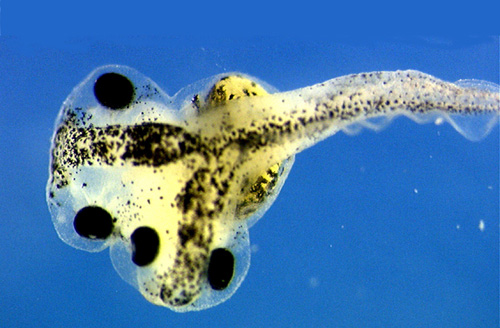
Xenopus embryo with two heads, resulting from experimental overactivation of the head inducer Dickkopf1
© dkfz.de
How cells communicate with their environment via cell-cell interactions and by growth factors is a key question in the molecular life sciences, including tumor biology. Wnt signaling plays an important role in embryonic development and cancer. In our Division of Molecular Embryology we study mechanisms of Wnt pathway regulation. To this end, we identify developmental control genes, investigate what their biological role and biochemical mode of action is, and how the genes are regulated. Our particular interest is to investigate signal transduction of Wnt receptors and associated cofactors. We study mouse and frog embryos as well as organoid- and mammalian cell culture as model systems and we make use of innovative molecular technologies for their analysis. Thus, we follow a comprehensive approach spanning from the biochemical to the organismic level, to unravel the Wnt signaling network and its biological role, as a basis for novel translational approaches in tumor biology.
Future Outlook
We pursue four main lines of research. First, we investigate the role of Wnt signaling in cell cycle regulation, notably mitosis. We found that Wnt signaling affects cell division by a novel posttranscriptional pathway and we are identifying the relevant Wnt target proteins. Second, we study the role and biochemical mechanism of signaling of Rspondins, stem cell growth factors, which we had previously discovered as Wnt signaling agonists. Third, we investigate the role of RNA helicases in protein kinase regulation in the context of Wnt signaling. Fourth, we screen for- novel Wnt pathway components and characterize them.
