Diversity, Equity and Inclusion
The German Cancer Research Center (DKFZ) pursues the vision "Research for a life without cancer" and is committed to diversity, equity and inclusion (DEI). The DKFZ brings together people from over 90 nations to conduct excellent research in the fight against cancer. DEI is a key success factor for excellence in cancer research, as it leads to diversity of perspectives, higher innovation potential and ultimately better scientific performance.
Diversity
Diversity encompasses the broad spectrum of individual backgrounds, experiences, and perspectives shaped by various dimensions, including gender and gender identity, age, ethnic background and nationality, religion and worldview, sexual orientation, socioeconomic status, and physical or mental abilities. These aspects not only define individual identities but also significantly influence problem-solving approaches and the capacity for creative solutions.
In research, diversity plays a crucial role as it directly enhances the quality and relevance of scientific outcomes. Diverse teams bring a variety of perspectives, fostering innovation and enabling the examination of complex issues from multiple angles. This results in more robust research findings and stronger alignment with the needs of a global and diverse society.
At the German Cancer Research Center (DKFZ), the international workforce, comprising individuals from over 90 nationalities, drives innovative research approaches and supports scientific excellence. The global nature of modern research necessitates a reflective and intersectional diversity strategy to mitigate structural discrimination and ensure that all dimensions of human diversity are integrated into scientific discourse.
Furthermore, diversity in research is essential for effectively addressing societal challenges. It ensures that the solutions developed are inclusive and applicable to diverse target groups—an indispensable factor in tackling global issues such as health, climate change, and social justice.
The “DIVERSUM” Project at the German Cancer Research Center (DKFZ) is a transformative initiative aimed at embedding diversity, equity and inclusion (DEI) into the core of the organization’s structures, processes, and culture. Recognizing DEI as a cornerstone of scientific excellence, the project builds on DKFZ’s existing commitments, including its adherence to the “Charta der Vielfalt” (Diversity Charter) and the implementation of the “Gender Equality, Diversity, and Inclusion Plan” (GEDIP). By fostering a culture of belonging, respect, and inclusion, the project seeks to create an environment where every individual can thrive.
Objectives of the Project
The DIVERSUM Project is centered on three strategic objectives designed to strengthen DEI at DKFZ:
- Establishing Professional Diversity Management: A dedicated diversity management system will be developed, focusing on the implementation and coordination of strategic DEI initiatives. A DEI Manager will act as the central point of contact, supporting employees and ensuring the integration of diversity and inclusion into all organizational processes.
- Developing Diversity-Sensitive Employer Branding: The project aims to position DKFZ as a leading and inclusive employer in the global research landscape. By showcasing the organization’s commitment to all dimensions of diversity, it seeks to attract a broad and international talent pool.
- Achieving Gender Parity in Scientific Leadership: The project incorporates targeted measures to increase the representation of women in scientific leadership roles, including gender-balanced shortlists for recruitment and enhanced mentoring and training programs for women.
Key Measures
To achieve these objectives, the DIVERSUM Project integrates a range of comprehensive and interlinked measures:
- Diversity Monitoring and Reporting: A data-driven approach will monitor diversity metrics across key dimensions, regular DEI reports and pulse surveys will generate actionable insights into the organization’s culture and identify areas for improvement.
- Awareness and Training Programs: A series of workshops and training sessions, including DEI trainings, will enhance awareness and build capacity among employees and leaders.
- Centralized DEI Hub: A centralized resource hub will be established to provide employees with support, consultation, and information on DEI-related matters.
- Inclusive Recruitment Practices: The project emphasizes inclusive hiring practices to ensure fair opportunities for all candidates.
- Recognition and Rewards: A Diversity Award will be introduced to recognize individuals and teams for their contributions to DEI within DKFZ, promoting visibility and highlighting the importance of DEI within the organization.
Importance of DIVERSUM for DKFZ
The DIVERSUM Project represents a steadfast commitment to fostering an environment where DEI is not only respected but actively leveraged to enhance research outcomes. By uniting individuals from diverse backgrounds, DKFZ seeks to unlock innovative ideas, accelerate scientific breakthroughs, and address global health challenges more effectively.
Additionally, the project strengthens DKFZ’s position as a leader in the international research community by aligning its values and practices with global standards of DEI. This alignment enhances DKFZ’s reputation while ensuring that its research outcomes remain socially relevant and impactful.
Long-Term Vision
Beyond its immediate objectives, the DIVERSUM Project is designed to establish a foundation for sustainable change. By integrating DEI into DKFZ’s strategic priorities, the organization aims to cultivate a culture of belonging that endures beyond the project’s timeline. This ensures that DEI remains integral to DKFZ’s mission of “Research for a Life Without Cancer.”
Equity
At DKFZ, we have a long-standing tradition of promoting fairness and inclusion. For many years, this commitment has been championed by our Equal Opportunities Officer—a role dedicated to addressing gender imbalances and ensuring fair treatment for all. This role remains a vital part of our organization, and its name is retained as it is mandated by law.
However, as our understanding of diversity and inclusion evolves, so too must our language and approach.
We now recognize that "equal opportunities" is not enough. While the phrase implies fairness, it assumes that everyone starts from the same place and faces the same challenges. In reality, opportunities are never truly equal because individuals bring diverse backgrounds, experiences, and circumstances to the table. This is why we embrace the concept of equity as a cornerstone of our Diversity, Equity, and Inclusion (DEI) strategy. Equity means creating tailored approaches to ensure that everyone has access to the resources, support, and opportunities they need to thrive. It acknowledges that different individuals and groups may require different solutions to achieve fair outcomes.
The role of the Equal Opportunities Officer at DKFZ is firmly grounded in German law. It is mandated by the Bundesgleichstellungsgesetz (Federal Gender Equality Act, BGleiG) and the Ausführungsvereinbarung Gleichstellung (Implementation Agreement on Gender Equality, AV-Glei). These legal frameworks provide a clear mandate to:
- Promote gender equality within the organization by addressing imbalances and fostering an inclusive workplace culture.
- Ensure compliance with gender equality provisions in all areas of organizational decision-making, including recruitment, promotion, and resource allocation.
- Act as an advocate and advisor on issues of equality and fairness, offering guidance to both leadership and staff.
- Monitor and report on the organization’s progress in achieving gender equality goals, ensuring transparency and accountability.
These laws underline the importance of institutional roles like the Equal Opportunities Officer in achieving equity and fairness in the workplace. At DKFZ, we are committed to upholding these legal principles while expanding our efforts to embrace the broader concept of equity within our Diversity, Equity, and Inclusion strategy.
The Equal Opportunities Officer plays a crucial role in ensuring fairness and equity during the recruitment and appointment processes at DKFZ. As mandated by the Bundesgleichstellungsgesetz and the AV-Glei, the Equal Opportunities Officer is a member of the Berufungskommission (appointment committee) for all scientific leadership positions. This ensures that gender equity considerations are integrated into every stage of the recruitment process.
The legal mandate requires that the Equal Opportunities Officer:
- Actively participates in discussions and decisions related to the appointment of leadership roles.
- Advocates for balanced representation of genders among candidates.
- Ensures that all recruitment and appointment procedures comply with gender equity regulations.
- Identifies and addresses potential biases or systemic barriers within the selection process.
The DKFZ Equal Opportunities Officer is an active member of the Helmholtz Association Working Group for Women in Research Centres (Akfifz), a network of the equal opportunities officers of the Helmholtz Centers. They meet twice a year to discuss cross-center topics in gender equity work, advise the management of the Helmholtz centers, the Helmholtz Head Office, and other bodies and represent the Helmholtz Association on gender equity issues to the outside.
Inclusion
Inclusion refers to the intentional and active process of creating an environment where all individuals are equally respected, valued, and involved, fostering a sense of belonging and enabling them to contribute their skills and perspectives without restriction. Its aim is to identify and dismantle barriers—whether physical, cultural, or social—to promote equity and sustainable participation. Unlike mere integration, which seeks to fit individuals into existing structures, inclusion critically examines those structures themselves. The focus lies on cultivating a culture that embraces diversity as a strength, recognizing different backgrounds, experiences, and identities as essential resources for innovation and collaboration.
At DKFZ, we adopt an intersectional understanding of inclusion, acknowledging the interplay and overlapping effects of various dimensions of diversity. Inclusion is not a static state but an ongoing process requiring continuous learning, reflection, and adaptation of our practices to foster an environment where everyone feels welcomed and respected. Key measures include the use of diversity-sensitive language, accessible structures, unbiased decision-making processes, and fostering dialogue and exchange across all levels.
In an organization like DKFZ, which is dedicated to cutting-edge cancer research, inclusion is not only a moral obligation and responsibility but also a strategic advantage. Diversity fosters creative solutions, broadens perspectives, and enhances innovation. An inclusive organizational culture also strengthens employee engagement and positions DKFZ as an attractive employer—particularly for talent from around the globe.
The representative of severely handicapped persons takes care of all the concerns of employees with disabilities. Every four years, the severely handicapped and equivalent employees of the DKFZ have the opportunity to vote. They elect the representative and their deputies in a separate, secret ballot. Their most important task is to enable severely handicapped employees to participate in working life and to represent their interests.
In all matters that affect an individual or severely handicapped employees as a group, the representative of severely handicapped persons must be informed by DKFZ in a timely and comprehensive manner and consulted before deciding.They support employees in applying for a severely handicapped ID card or equal status with a severely handicapped person. They are also the right contact when considering whether you need specific equipment at your workplace or working time models that are specially adapted to you.
Do you have a health impairment and are undecided whether to disclose it in a professional setting? Maybe this website will help you decide.
The team currently consists of four people.
Contact person: Sibylle Szabowski
Anti-Discrimination and Anti-Racism
The General Equal Treatment Act (AGG) provides for a right of appeal and the establishment of a complaints office for employees in cases of discrimination (§13 AGG).
Affected persons and their supporters must not be disadvantaged by exercising their right of appeal.
Important note: The complaints procedure is a formal procedure of the DKFZ. In contrast to confidential counselling, the complainant has no right to confidential, anonymous treatment of the complaint.
Contact person: Jasmin Greff
The municipal anti-discrimination office in Heidelberg offers support for people who have experienced discrimination, as well as for anyone who wants to actively work against discrimination. Discrimination occurs when people are disadvantaged or devalued without objective reason – for example, because of their ethnic origin, skin colour, language, gender identity, religion or belief, disability, age or sexual identity. The Office for Equal Opportunities serves as a central point of contact and provides information about counselling and action options.
Please note that the municipal anti-discrimination office can only take action if the incident has occurred in Heidelberg or if Heidelberg residents are affected. Further information and support options can be found on the website of the municipal anti-discrimination office in Heidelberg.
The State of Baden-Württemberg's Anti-Discrimination Agency (LADS) was established in November 2018 and is part of the Ministry of Social Affairs, Health and Integration. Its work is based on the principle of the German constitution: ‘Human dignity is inviolable.’ Discrimination attacks this dignity and poses a challenge not only for the individuals affected, but for society as a whole. Anti-discrimination work is therefore an essential part of democracy – in Baden-Württemberg, in Germany and in Europe.
LADS aims to create a society in which discrimination is recognised and punished and in which those affected receive support – whether in their private lives, at work or in public. To prevent discrimination, LADS develops strategies and works with relevant stakeholders in Baden-Württemberg and Europe. It also supports those affected in their search for a suitable advice centre.
There are LADS-funded advice centres against discrimination in nine cities in Baden-Württemberg. In addition, a central advice centre is available for people who live in regions without a specific point of contact.
If you have experienced discrimination or have questions about the work of LADS, you can contact the Anti-Discrimination Office of the State of Baden-Württemberg (LADS) by phone or email.
The Federal Anti-Discrimination Agency is committed to protecting against discrimination and promoting equal treatment in Germany. It was set up on the basis of the General Equal Treatment Act (AGG) and is an independent advice and information centre for people who have experienced disadvantage or are committed to a discrimination-free society.
Discrimination can occur in many areas of life – for example at work, when looking for a flat, in education, in services or in healthcare.
The Federal Anti-Discrimination Agency provides information, advice and support to people who have experienced discrimination.
It offers:
- Individual advice: those affected receive confidential and independent initial advice on their rights and possible courses of action.
- Referrals to advice centres: In many cases, a specialised advice centre or an ombudsman can offer further support. The Anti-Discrimination Agency helps you find the right point of contact.
- Public relations work and awareness-raising: Through studies, campaigns and events, the Anti-Discrimination Agency is committed to a discrimination-free society.
- Recommendations for policy and legislation: The office drafts proposals for the further development of protection against discrimination and advocates structural changes.
If you are affected by discrimination or have questions about protection against discrimination, you can contact the Federal Anti-Discrimination Agency in confidence.
At DKFZ, we acknowledge that the demands of high-level research and professional responsibilities can sometimes lead to stress, conflicts, or personal challenges. Recognizing the complex interplay between professional and personal well-being, we provide various support mechanisms to offer guidance and assistance in navigating such situations.
Internal Support: Confidential Advisors
DKFZ has established a network of internal confidential advisors, all of whom are trained Mental Health First Aiders. Among them is the Equal Opportunity Officer, serving as a key point of contact. These advisors provide a secure and confidential environment for discussing concerns, obtaining guidance, and receiving emotional support. They assist in managing stress, addressing conflicts, and, when necessary, facilitating referrals to specialized professional support services.
External Professional Counseling Services: Independent and Cost-Free
DKFZ employees at all locations have access to external, independent, and fully confidential counseling services, ensuring comprehensive professional support. These services include:
- BAD GmbH – A professional occupational health service providing psychological counseling and support for work-related challenges.
- Viva Family Service – A specialized provider offering psychosocial counseling and expert guidance on issues related to occupational stress, family responsibilities, mental health concerns, and crisis intervention.
By integrating both internal and external support structures, DKFZ fosters a work environment that prioritizes mental well-being, professional resilience, and a culture of support. These measures reflect our institutional commitment to sustaining a research environment where employees can thrive both professionally and personally.
Work-Life Well-being
DKFZ offers a range of flexible working options to support employees in balancing their professional and personal lives. These include flexible working hours, opportunities for mobile working within Germany, and options to adjust working hours or take leave for care-giving responsibilities. Employees can discuss and arrange these options with their supervisors. These measures are designed to promote a supportive and adaptable work environment.
Find out more about working at DKFZ
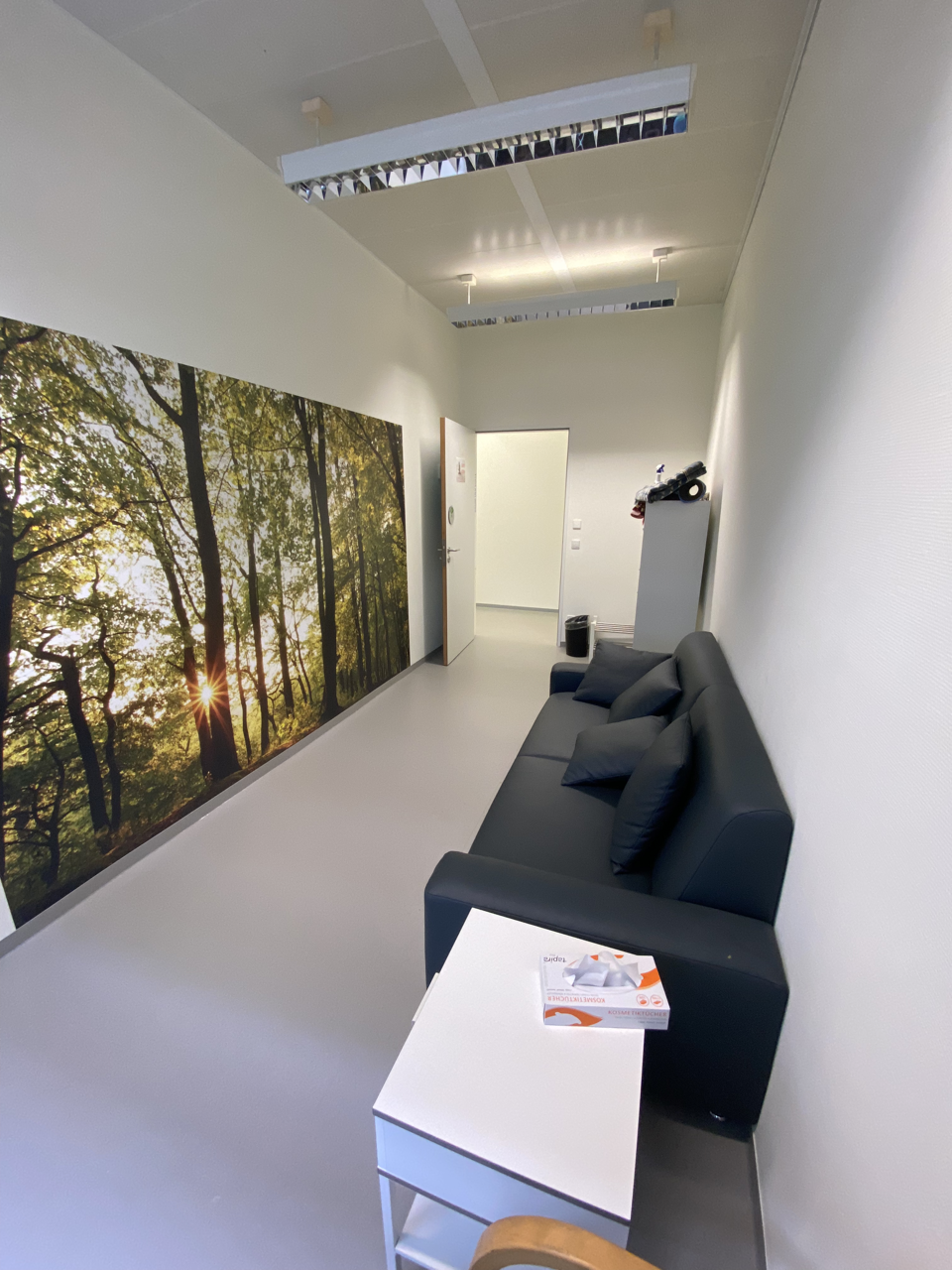
The DKFZ provides two multi-faith ‘Quiet Rooms’, offering employees a peaceful space for meditation, prayer, or moments of reflection. These rooms are thoughtfully furnished with comfortable seating, a small table, storage, and a coat rack to ensure a welcoming environment. The Quiet Rooms are open to all employees and do not require prior booking.
Offers for families
At DKFZ, we recognize that families come in all shapes and sizes. We believe that the important relationships in your life matter deeply. Instead of defining what "family" means, we honor the diversity of our employees’ lives and relationships.
Our goal is to foster an environment where your personal connections and professional responsibilities can thrive side by side. We understand that a fulfilling personal life contributes to professional success, and we’re committed to supporting a workplace where you don’t have to choose between the two.
At DKFZ, we are committed to providing a safe and supportive environment for employees during pregnancy and parental transitions, in full compliance with legal requirements. These regulations are designed to ensure the health, well-being, and rights of employees during this important time.
What the Law Says:
The German Maternity Protection Act (Mutterschutzgesetz, MuSchG) establishes specific protections for employees who are pregnant, have recently given birth, or are breastfeeding. These include:
- Adjustments to working conditions to safeguard health and safety during pregnancy.
- Prohibition of certain types of work and working conditions that may pose risks.
- Protection against dismissal during pregnancy and parental leave.
- Parental leave rights as defined in the Parental Leave Act (Bundeselterngeld- und Elternzeitgesetz, BEEG).
For more information, you can refer to these guides:
- Guide to Maternity Protection (English)
- Guide to The Federal Parental Allowance and Parental Leave Act (Bundeselterngeld- und Elternzeitgesetz) (English)
Support and Advice:
Our Equal Opportunities Officer is available to provide confidential advice and support for employees who are pregnant or planning parental leave. They can help clarify your rights, discuss workplace adjustments, and provide guidance tailored to your situation.
Resources for Parents-to-Be:
DKFZ offers a comprehensive guide for parents-to-be. This guide is designed to help you navigate this period with confidence and clarity.
At DKFZ, we are committed to fostering an inclusive environment that supports all employees in balancing their personal and professional lives. If you have any questions or need assistance, please do not hesitate to reach out to the Equal Opportunities Officer.
DKFZ has two “parent-child-rooms”, one in the main building and one in the Technologiepark, with all the necessary equipment, including a PC workstation. The parent-child room provides rest facilities for pregnant employees when needed and allows employees with infants to breastfeed and work in a quiet and discreet environment.
DKFZ subsidizes childcare places at two nearby childcare facilities, that provide care for children ages 6 months to 6 years:
- Die Wichtel
Im Neuenheimer Feld 583
69120 Heidelberg
http://www.verein-beruf-und-kind.de/
- Glückskinderwelt
Bergheimer Str. 147
69115 Heidelberg
https://www.glueckskinderwelt.de/de
You can find more childcare facilities in Heidelberg at: www.meinkind.de (German-language site)
In urgent cases, the University of Heidelberg offers a BACKUP service.
Our collaboration partner Bündnis für Familie Heidelberg provides a list of babysitters and the possibility to post your own requirements at Babysitterbörse.
Lectures and information on the topic of caring for relatives.
Since 2010, the DKFZ has also been working closely with the City of Heidelberg's "Alliance for Family". The alliance also includes, among others, the Ruprecht Karls University of Heidelberg, Heidelberg University Hospital, the Employment Agency, SAP, and the Heidelberg Tax Office.
In addition to the series of lectures "Family Care from A to Z" (Angehörigenpflege von A bis Z), which has been held regularly for many years, the alliance also offers a lot of information and links to the care support center and the social services of the city of Heidelberg.
Points of contact outside Heidelberg
Anyone looking for a contact point in the vicinity can search for topics such as care, housing, dementia or complaints at https://www.zqp.de/english/ by entering their place of residence or zip code.
In addition, the German Federal Ministry for Family Affairs, Senior Citizens, Women and Youth (BMFSFJ) has set up an internet portal site that provides information and help in dealing with care patients and dementia.
Employee Networks
The DKFZ Executive Women's Initiative was founded in 2011 to foster female leadership and promote the interests of women in executive positions at the institute.
The EWI aims to strengthen female participation at the DKFZ, to raise awareness to the female perspective and voice as well as to mentor young scientists, in order to create a more equal workplace for future generations of female scientists.
They meet four times per year as full plenum while an elected steering committee represents the Initiative in general.
The current steering committee was voted into office in July 2022. It consists of:
Angela wants to focus on female mentorship and leadership; highlighting alternatives to a "classic male leadership style" and inclusion of new measures for scientific success.
Marieke wants to keep the impact of Covid on women on the agenda; It is an inherently women-related topic and we need to focus on the female perspective of consequences of the pandemic.
Barbara wants to focus on female mentorship and leadership; Programs aimed at female junior group leaders need clarity and to be coordinated.
This gathering is dedicated to LGBTQIA+ members at DKFZ, offering a safer space to discuss topics relevant to the queer community within and beyond our organization. The focus is on fostering connections, sharing experiences, and building a sense of belonging.
Feel free to bring snacks and drinks to enjoy during the meeting!
What does “Queer” mean?
The term “queer” is an inclusive umbrella term used to describe individuals whose sexual orientation, gender identity, or expression does not conform to societal norms or expectations. Originally reclaimed by the LGBTQIA+ community, “queer” embraces a broad spectrum of identities, including but not limited to lesbian, gay, bisexual, transgender, nonbinary, intersex, questioning, asexual, and pansexual individuals. The term is intentionally fluid and resists rigid definitions, celebrating the diversity and complexity of human experiences.
Participation Details
This event is a closed meeting, limited to individuals who identify as LGBTQIA+. We kindly request allies and supporters of the queer community not to attend this specific gathering. This approach helps ensure a safe and comfortable environment, especially for those who may not be public about the topic.
Upcoming Events Open for Allies and the Community
We deeply value the support of allies and are planning to organize open events later in 2025. These events will be open to everyone interested in engaging with queer topics and supporting the LGBTQIA+ community. Further details and announcements will be shared soon—stay tuned!
Questions or Suggestions?
If you have any questions about the meet-up or if you are an ally interested in supporting or co-organizing future events, please don’t hesitate to contact us. We welcome your input and look forward to creating meaningful connections and impactful initiatives together.
Parents at DKFZ is a new employee network for parents, in collaboration with the ‘Netzwerk Mutterschaft und Wissenschaft’. Employees can join the mailing list to find out more about events.
Principles & Commitments
The DKFZ has been a signatory of the German Diversity Charter since 2022. This means that we are committed to the terms of the Charter.
The DKFZ has been certified "berufundfamilie" by the Hertie Foundation since 2006. This nationally recognized strategic management tool demonstrates high standards of work-life planning established by the DKFZ.
DKFZ has been a member of the ‘Erfolgsfaktor Familie’ network for 15 years.
Upcoming Events
Join us for this year's series of lectures and discussions during the International Weeks Against Racism.
Dr. Elisabeth Becker-Topkara
In this talk, I will draw on my research with Jewish communities and antisemitism education across Europe and the United States to examine the contours of contemporary antisemitism. While antisemitism has deep historical roots, its present-day manifestations represent both continuities with the past and distinctly new formations. I will explore how antisemitism fundamentally constrains Jewish belonging—individually and collectively—in Europe and globally. I will examine antisemitism across the political spectrum, from far-right to far-left movements, as well as its presence in mainstream discourse. And I will analyze how transnational political conflicts become layered onto questions of local Jewish belonging, often positioning Jewish communities as perpetually foreign or conditionally accepted. Crucially, I will highlight how Jewish individuals and communities exercise agency in responding to antisemitism, engaging in creative forms of resistance, solidarity-building, and collective self-determination. Finally, I will consider the complex relationships between antisemitism and other forms of racism and exclusion—how they intersect, reinforce one another, or diverge—and what this means for building coalitions against all forms of discrimination.
16th March, 10:00-11:30Uhr
Prof. Dr. Natasha A. Kelly
Was bedeutet es, krank zu sein und zugleich in einer Gesellschaft zu leben, in der Körper unterschiedlich gelesen, bewertet und behandelt werden? In ihren Krebstagebüchern beschreibt die Schwarze US-amerikanische Dichterin und Aktivistin Audre Lorde ihre Brustkrebserkrankung als zutiefst körperliche, aber auch politische Erfahrung. Sie verbindet persönliche Verletzlichkeit mit einer radikalen Analyse von Sprache, Medizin, Macht und struktureller Ungleichheit. Im Rahmen der Internationalen Woche gegen Rassismus nimmt der Vortrag Audre Lordes Texte als Ausgangspunkt, um Fragen nach rassismuskritischer Gesundheitsversorgung, Sichtbarkeit von Patient:innenperspektiven und der Rolle von Institutionen im Umgang mit Krankheit zu diskutieren. Der Vortrag lädt dazu ein, Krebs nicht nur als medizinische Diagnose, sondern auch als gesellschaftliches Ereignis zu verstehen und darüber nachzudenken, was gerechte Versorgung und solidarisches Handeln bedeuten können.
18. März, 13:30-14:30Uhr
Dzeneta Isakovic
Was genau ist (Rechts)Extremismus und wie äußert er sich in unserer Gesellschaft, in Sprache, Verhalten oder Strukturen? In diesem Workshop setzen wir uns mit den Erscheinungsformen extremistischer und menschenfeindlicher Ideologien auseinander und betrachten, wie sie sich im Alltag bemerkbar machen. Ein besonderer Fokus liegt dabei auf rassistischer Stigmatisierung bestimmter Gruppen der Gesellschaft.
Der Workshop lädt zur Reflexion ein, wie (subtile) Formen extremistischer Haltungen auch in Arbeitskontexten sichtbar werden können und welche Verantwortung jede und jeder Einzelne trägt, um diesen entgegenzutreten.
Gerade für ein Forschungszentrum wie das DKFZ, das auf Vielfalt, internationale Zusammenarbeit und wissenschaftliche Integrität setzt, ist es essenziell, sich aktiv mit Extremismus und Rassismus auseinanderzusetzen und eine klare, antirassistische Haltung zu fördern. Nur so kann Forschung in einem Umfeld gelingen, das auf Respekt, Offenheit und gegenseitigem Vertrauen basiert.
19. März, 10:00-12:30Uhr
Noemi Zenk-Agyei, Ivan Murilloc, Narasimha Sushil
Panel discussion hosted by Hollyn Hartlep, DKFZ Sustainability Manager
Climate change is not only an environmental crisis it is also a matter of justice. This panel explores how global health, climate change and racial justice are deeply interconnected. Bringing together diverse perspectives from the Global North and Global South, our speakers will examine how structural inequalities shape both the causes and the consequences of the climate crisis. The discussion will address how environmental racism affects human health, why sustainable development cannot succeed without confronting systemic racism and why institutions must actively engage in these conversations.
24th March, 10:00-11:30
Stève Hiobi
Wer Afrika als „Forschungsraum“ bezeichnet, sollte auch fragen: Wer produziert Wissen über wen – und unter welchen Machtverhältnissen? In diesem Vortrag beleuchtet Afrofluencer die historischen und strukturellen Bedingungen von Wissensproduktion über Afrika, insbesondere im Kontext von Gesundheit und Medizin. Dabei spannt er den Bogen von vorkolonialen Wissenssystemen über koloniale Wissenschaft und medizinische Pseudotheorien bis hin zu postkolonialen Kontinuitäten in der globalen Gesundheitsforschung.
26. März, 10:00-11:30Uhr
Past Events
Mitreden. Mitdenken. Mitmachen.
Im Mai und Juni standen am DKFZ Vielfalt, Chancengerechtigkeit und Inklusion im Fokus. Rund um den Deutschen Diversity Tag am 27. Mai 2025 organisierte das DEI-Management & Gleichstellungsbüro eine Veranstaltungsreihe zu den sieben Kerndimensionen von Diversity.
Vielfalt verbindet – und macht gemeinsam stärker.
Ein vielfältiges Programm – darunter Diversity-Lunch Talks, Impulsvorträge und interaktive Formate – schuf Raum für Reflexion, Austausch und neue Impulse. Es wurden zentrale Aspekte wie Alter, Geschlecht, ethnische Herkunft, Religion, sexuelle Orientierung, soziale Herkunft und Behinderungen aufgegriffen und ebenfalls beleuchtet, wie sich diese Dimensionen überschneiden und gegenseitig beeinflussen.
Die Betrachtung der sieben Kerndimensionen von Diversity schafft eine strukturierte Grundlage, um Vielfalt in Organisationen zu verstehen und gezielt zu fördern. Das ermöglicht einen ganzheitlichen Blick auf Diversity: multidimensional und intersektional.
Das DKFZ versteht Diversity, Equity und Inclusion (DEI) nicht nur als gesellschaftliche Verantwortung, sondern auch als strategischen Erfolgsfaktor. Unterschiedliche Perspektiven, Erfahrungen und Hintergründe fördern Innovation und wissenschaftliche Exzellenz. Dies sind zentrale Voraussetzungen für die Umsetzung der Vision:
Forschen für ein Leben ohne Krebs.
Veranstaltungsübersicht
- Alter
• 06.05.2025 09:00 - 12:00 Uhr: Angehörigenpflege von A-Z: „In die Zukunft gedacht: Vorsorgen!“
• 09.05.2025 11:00-12:00 Uhr: Individuell statt klischeehaft: Generationenvielfalt als Gewinn
• 19.05.2025 09:00 - 12:00 Uhr: Angehörigenpflege von A-Z: „Wie organisiere und finanziere ich Angehörigenpflege?“ - Soziale Herkunft und Soziale Nachhaltigkeit
• 15.05.2025 15:00 - 16:30 Uhr: Social Sustainability Workshop
• 19.05.2025 12:00 - 13:00 Uhr: From working-class child to academic - still a fairy tale? - Geschlecht und geschlechtliche Identität
• 20.05.2025 11:00 - 12:00 Uhr: Konflikte und Bewältigungsstrategien von Müttern bei der Vereinbarkeit von Familie und Beruf
• 21.05.2025 11:00 - 12:00 Uhr: Sex and Gender in Research
• 22.05.2025 16:00 - 17:00 Uhr: Frauengesundheit - in der Mitte des Lebens - Sexuelle Orientierung
• 28.05.2025 12:00 - 13:00 Uhr: LSBTIG+ - Leben und Arbeiten in Deutschland - Religion und Weltanschauung
• 02.06.2025 12:00 - 13:00 Uhr: Muslimische Lebenswelten - Chancen und Spannungsfelder
• 05.06.2025 10:00-12:00 Uhr: Antiziganismus - Die Biowissenschaften und der Völkermord an den Sinti und Roma - Körperliche und geistige Fähigkeiten
• 10.06.2025 12:00 - 13:00 Uhr: Benachteiligung von Menschen mit Krebserkrankungen im Berufs- und Privatleben
• 11.06.2025 11:00 - 12:00 Uhr: Potenziale und Risiken von KI-Systemen für eine inklusive Gestaltung von Arbeit für Menschen mit Behinderungen
• 11.06.2025 13:00 - 16:00 Uhr: Inclusions-Parcours
• 12.06.2025 10:00 - 14:00 Uhr: Inclusions-Parcours
• 13.06.2025 13:00 - 14:00 Uhr: Vorstellung des Betrieblichen Gesundheitsmanagements - Ethnische Herkunft und Nationalität
• 16.06.2025 12:00 - 13:00 Uhr: Impulse aus den Internationalen Wochen gegen Rassismus
• 18.06.2025 10:00 - 11:30 Uhr: Umgang mit antidemokratischen Äußerungen
• 20.06.2025 10:00 - 12:00 Uhr: Antiasiatischer Rassismus in Deutschland
Hier geht es zur Bildergalerie:
t3://file?uid=17038
Veranstaltungsübersicht
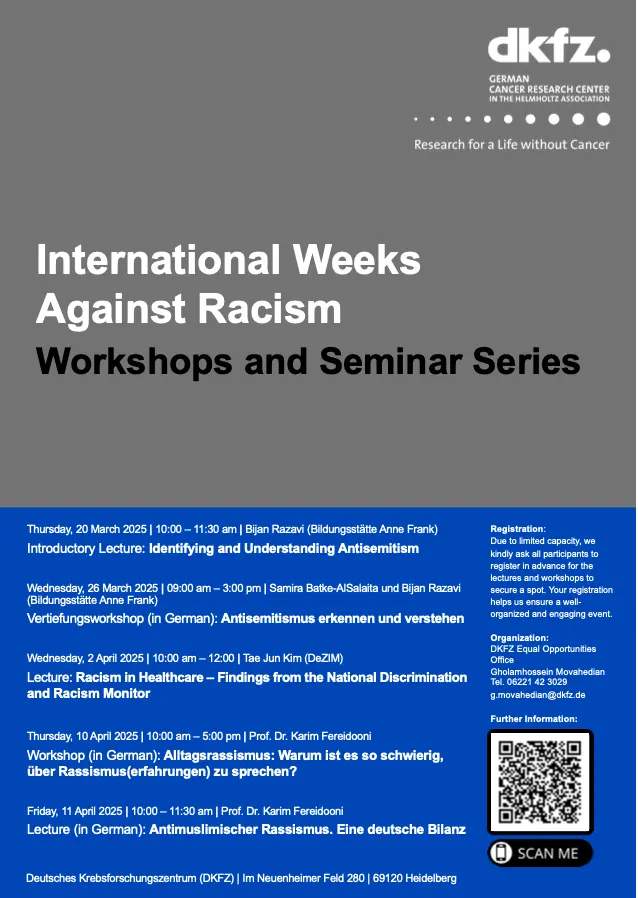
1. Thursday, 20 March 2025 | 10:00 – 11:30 am | Bijan Razavi (Bildungsstätte Anne Frank)
Introductory Lecture: Identifying and Understanding Antisemitism
2. Wednesday, 26 March 2025 | 09:00 am – 3:00 pm | Samira Batke-AlSalaita und Bijan Razavi (Bildungsstätte Anne
Frank) Vertiefungsworkshop (in German): Antisemitismus erkennen und verstehen
3. Wednesday, 2 April 2025 | 10:00 am – 12:00 | Tae Jun Kim (DeZIM)
Lecture: Racism in Healthcare – Findings from the National Discrimination and Racism Monitor
4. Thursday, 10 April 2025 | 10:00 am – 5:00 pm | Prof. Dr. Karim Fereidooni
Workshop (in German): Alltagsrassismus: Warum ist es so schwierig, über Rassismus(erfahrungen) zu
sprechen?
5. Friday, 11 April 2025 | 10:00 – 11:30 am | Prof. Dr. Karim Fereidooni
Lecture (in German): Antimuslimischer Rassismus. Eine deutsche Bilanz
Hier geht es zur Bildergalerie:
t3://file?uid=17043
Monnem Pride 2024
Hier geht es zur Bildergalerie:
t3://file?uid=17042
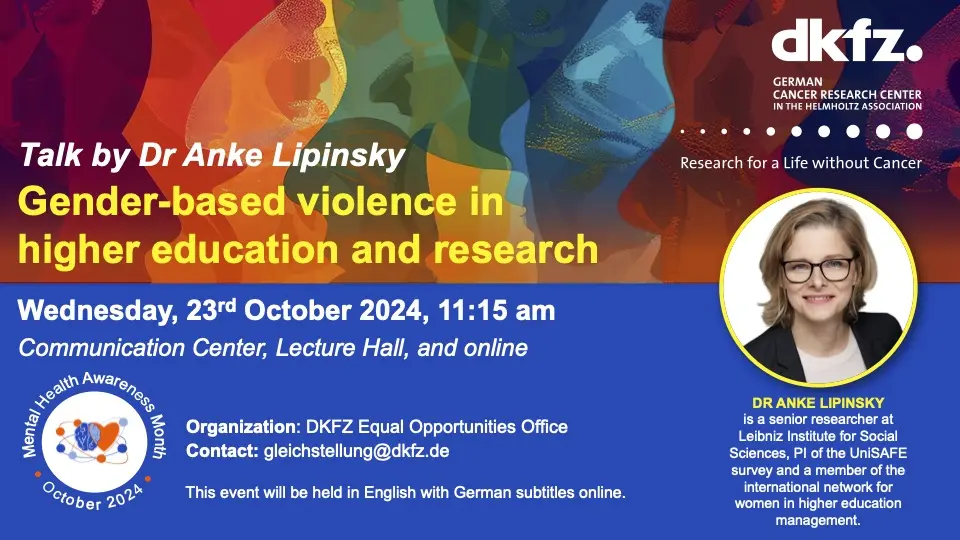
Dr. Anke Lipinsky, leitender Forscherin am GESIS - Leibniz-Institut für Sozialwissenschaften, Team CEWS. Sie ist PI der quantitativen Umfrage von UniSAFE und Mitglied des internationalen Netzwerks für Frauen in der Hochschulverwaltung WHEM. Ihre Forschungsschwerpunkte liegen auf geschlechtsspezifischen Ungleichheiten in der Wissenschaft, Politikevaluierung und Forschungsmethoden sowie geschlechtsspezifischer Gewalt, einschließlich sexueller Belästigung. Sie war an mehreren von der EU finanzierten Projekten beteiligt, z. B. INSPIRE, UniSAFE, GEECCO, GenPORT und INTEGER. Dr. Lipinsky diente in mehreren Expert:innengruppen der Europäischen Kommission, einschließlich der Gendered Innovations Gruppe.
Vortragsbeschreibung:
Das von der EU finanzierte Forschungsprojekt „Geschlechtsspezifische Gewalt und institutionelle Reaktionen“ (UniSAFE) implementierte von 2021 bis 2024 ein mehrstufiges und standortübergreifendes Forschungsdesign. Eine groß angelegte Online-Befragung bildete einen zentralen Bestandteil der Forschung und sammelte Daten von 46 Hochschul- und Forschungseinrichtungen in 15 europäischen Ländern. Ergänzend zur quantitativen Studie führte das Forschungsteam 54 halbstrukturierte Interviews mit Mitarbeitenden durch, die geschlechtsspezifische Gewalt am Arbeitsplatz erfahren haben. In ihrer Präsentation wird AnkeLipinsky zentrale Ergebnisse der UniSAFE-Forschung vorstellen, darunter konzeptionelle Neuerungen, die zur Weiterentwicklung des Wissens in diesem Bereich beigetragen haben. Die Ergebnisse zeigen, dass etwa zwei von drei Menschen in Hochschulen und Forschungseinrichtungen im Laufe ihrer Zugehörigkeit geschlechtsspezifische Gewalt erleben. Eine:r von drei Menschen erlebt sexuelle Belästigung. Dies gilt sowohl für Mitarbeitende als auch für Studierende. Im Vergleich zu Männern berichten Frauen und nichtbinäre Personen von mehr und wiederkehrenderen Gewalterfahrungen. Verschiedene Gewaltformen überschneiden sich und treten gemeinsam auf. Während 23 % der betroffenen Mitarbeitenden einen Vorfall melden, tun dies nur 7 % der betroffenen Studierenden. Der häufigste Grund für das Nichtmelden liegt in der Unsicherheit darüber, ob die Aggression ernst genug war. Betroffene berichten von Mängeln der bestehenden Richtlinien im Hochschulbereich, was die bereits weitreichenden Auswirkungen auf das Wohlbefinden, das Studium und den Karrierefortschritt verstärkt.
Das Projekt „Geschlechtsspezifische Gewalt und institutionelle Reaktionen“ (UniSAFE) wurde im Rahmen des Horizon 2020-Programms der Europäischen Union unter der Finanzhilfevereinbarung Nr. 101006261 gefördert.
Team
- Show profile
Dr. Amy Danson
Equal Opportunities Officer
- Show profile
Gholamhossein Movahedian
DEI Manager
- Show profile
Mervdy-Biya Nkangu
Office Coordinator
- Show profile

Dr. Fiona Brown
Deputy Equal Opportunities Officer
-
Dr. Silke Hermann
Deputy Equal Opportunities Officer
-
Sonja Janetzko
Deputy Equal Opportunities Officer