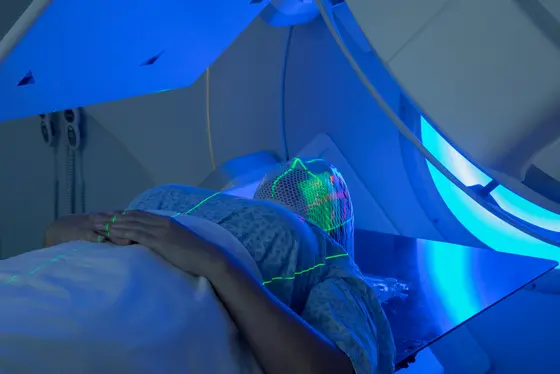
Radiation therapy is one of the most important “pillars” of cancer treatment. More than half of all cancer patients are treated with radiation during the course of their illness. However, radiation can also damage healthy tissue – especially the skin. These reactions range from acute inflammation and pain to chronic fibrosis, which can significantly impair quality of life and treatment success. Fibrosis is a pathological proliferation of connective tissue in which specialized tissue is replaced by scar-like connective tissue. Despite its clinical significance, the molecular causes of radiation damage are not yet fully understood.
Researchers from the DKFZ and the Medical Center of Ludwig Maximilian University of Munich (LMU) have joined forces to search for strategies to prevent skin damage during radiation therapy or even to treat existing damage. The teams focused on an important cellular signaling pathway that controls the growth of connective tissue cells. During these analyses, the protein Dickkopf-3, which modulates this signaling pathway, emerged as a key factor in radiation-induced skin reactions.
Radiation-induced skin reactions are based on complex biological processes involving cells of the epidermis, connective tissue, and immune cells. The new study shows in human skin* and mice that radiation increases the expression of Dickkopf-3 in keratinocytes, the horn-forming cells of the epidermis. This leads to cellular signals that promote the excess production of reactive oxygen species, accelerate cell growth, and activate the connective tissue cells responsible for the formation of scar tissue and fibrosis.
In addition, Dickkopf-3 influences the skin's immune response: It causes macrophages to transform into a fibrosis-promoting state that promotes inflammation and scarring.
Less fibrosis through blocking Dickkopf-3
A key finding of the study is that genetic blockade of Dickkopf-3 in mouse skin cells significantly reduced radiation-induced skin fibrosis. Importantly, the radiation sensitivity of the cells was not altered by switching off Dickkopf-3.
“Our results all indicate that Dickkopf-3 is a key factor in the development of radiation damage – and thus also a potential therapeutic target that could be used to modulate harmful radiation reactions,” summarizes Peter Huber, one of the heads of study
Co-study leader Roger Sandhoff also emphasizes: “Dickkopf-3 is not only relevant in radiation damage, but also in other chronic fibrotic diseases. The results could therefore have significance far beyond radiotherapy.”
The researchers see the discovery of Dickkopf-3 as a central regulator of the radiation response as the basis for further preclinical and clinical studies. The goal is to develop drugs or therapeutic strategies that modulate Dickkopf-3-mediated signals – to protect the skin and other healthy tissues during cancer treatment.
* Skin biopsies and 3D skin model in culture dish
Li Li, Ramon Lopez Perez, Khuram Shehzad, Richard Jennemann, Claudia Schmidt, Thomas Walle, Alexandra Tietz-Dahlfuß, Elisabeth Grimm, Joscha A. Kraske, Peter Häring, Uladzimir Barayeu, Tobias P. Dick, Luxi Ye, Stephan A. Braun, Michael Hertl, Thomas Worzfeld, Thorsten Wiech, Huihui Ji, Jing Su, Jonathan M. Schneeweiss, Muzi Liu, Katharina Kommoss, Matthias Heikenwälder, Bingwen Zou, Sabrina Mücklich, Kerstin Steinbrink, Verena K. Raker, Wenjun Wu, Elfriede Noessner, Hermann-Josef Gröne, Peter J. Nelson, Roger Sandhoff and Peter E. Huber: Wnt-associated DKK3 in keratinocytes mediates radiation-induced hyperplasia, dermatitis and skin fibrosis.
Signal Transduction and Targeted Therapy, 2026, https://doi.org/10.1038/s41392-025-02541-z


