Double ERC success for DKFZ researchers
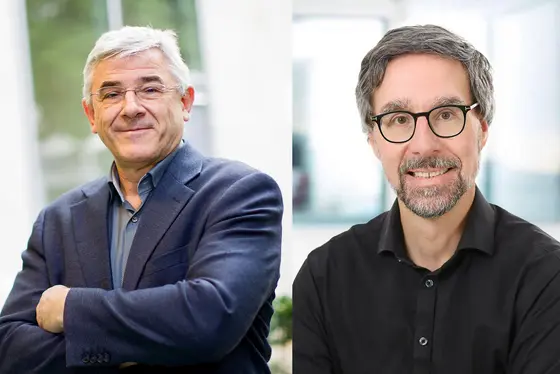
With its Proof of Concept (PoC) grants, the European Research Council (ERC) supports scientists in further developing the economic potential of their research results. Two scientists from the German Cancer Research Center (DKFZ) have now been selected for this prestigious funding: Hellmut Augustin is developing novel mouse tumor models that will ensure better transferability of results while reducing the number of animals used in experiments. Michael Platten plans to further develop an AI-driven classifier to accelerate the complex production of therapeutic T cells for immunotherapy.

What is special about the ERC's “Proof of Concept” grants is that only those who already receive ERC funding can apply for this grant. The Research Council wants to enable scientists to test and explore possible applications for the research results they have achieved in an ERC-funded project.
Cancer is extremely complex and affects the entire body, meaning that many questions can only be investigated in living organisms. Mice are used almost exclusively for this purpose. Researchers today use various techniques to study cancer in rodents. For example, tumor cells are transferred to the animal or cancer is induced through genetic engineering. However, the various approaches have disadvantages that often mean that the situation in humans is not adequately replicated. With the SpheroMouse project, Hellmut Augustin, head of the Department of Vascular Oncology and Metastasis at the DKFZ and the Department of Vascular Biology and Tumor Angiogenesis at the University Medical Center Mannheim, aims to improve the significance of this research. His goal is to better adapt the results from animal experiments to the situation in humans, thereby increasing the scientific quality and transferability of preclinical mouse tumor research.
His approach is based on transplanting tiny fragments of established tumors, barely a tenth of a millimeter in size, obtained from genetically modified mouse models. This procedure enables scientific findings with greater significance and significantly improved transferability to humans than the cell line tumor models that have been predominantly used to date. The fragments can be molecularly standardized, stored in biobanks, and conveniently shipped, making them available to researchers worldwide. At the same time, the project also makes a significant contribution to animal welfare, as more reproducible results in standardized models mean that fewer animals need to be used for experiments.
Personalized T-cell therapies are considered promising new treatment options for various types of cancer. The therapeutic T cells are first equipped in the laboratory with special sensor proteins, the “T-cell receptors,” which recognize the individual tumor. However, identifying the appropriate T-cell receptors is a particularly time-consuming step in the production of personalized therapeutic T cells.

Michael Platten is head of the Clinical Cooperation Unit Neuroimmunology and Brain Tumor Immunology at the DKFZ and director of the Neurological Clinic at the University Medical Center Mannheim. The physician and scientist recently developed an AI-driven classifier that identifies tumor-killing T-cell receptors from patient samples. “predicTCR” can reduce the time needed to identify therapeutic TCRs from around four months today to less than two weeks. With the ERC funding, Platten now wants to transform predicTCR from a research algorithm into a robust, validated, and fully automated process that is suitable for clinical use.
To this end, quality control measures will first be developed to prevent ineffective therapeutic cells from being selected. In addition, the researchers want to ensure that all necessary rules are followed when using predicTCR to select tumor-targeted T-cell receptors for a clinical trial. A compliant predicTCR would enable the development of cellular immunotherapies for rare types of cancer as well. Another goal of the researchers is to identify tumor-reactive T-cell receptors in order to develop “ready-to-use” cell therapies that are effective against many different types of cancer.
Photos of the grant recipients are available for download at:
https://www.dkfz.de/fileadmin/user_upload/Skoe/Pressemitteilungen/2026/Augustin.jpg
https://www.dkfz.de/fileadmin/user_upload/Skoe/Pressemitteilungen/2026/Platten.jpg
Note on use of images related to press releases
Use is free of charge. The German Cancer Research Center (Deutsches Krebsforschungszentrum, DKFZ) permits one-time use in the context of reporting about the topic covered in the press release. Images have to be cited as follows: “Source: Jutta Jung / DKFZ”.
Distribution of images to third parties is not permitted unless prior consent has been obtained from DKFZ’s Press Office (phone: ++49-(0)6221 42 2854, E-mail: presse@dkfz.de). Any commercial use is prohibited.
Get in touch with us

Press Contact
About DKFZ
With more than 3,500 employees, the German Cancer Research Center (Deutsches Krebsforschungszentrum, DKFZ) is Germany’s largest biomedical research institute. DKFZ scientists identify cancer risk factors, investigate how cancer progresses and develop new cancer prevention strategies. They are also developing new methods to diagnose tumors more precisely and treat cancer patients more successfully. The DKFZ's Cancer Information Service (KID) provides patients, interested citizens and experts with individual answers to questions relating to cancer.
To transfer promising approaches from cancer research to the clinic and thus improve the prognosis of cancer patients, the DKFZ cooperates with excellent research institutions and university hospitals throughout Germany:
- National Center for Tumor Diseases (NCT, 6 sites)
- German Cancer Consortium (DKTK, 8 sites)
- Hopp Children's Cancer Center (KiTZ) Heidelberg
- Helmholtz Institute for Translational Oncology (HI-TRON Mainz) - A Helmholtz Institute of the DKFZ
- DKFZ-Hector Cancer Institute at the University Medical Center Mannheim
- National Cancer Prevention Center (jointly with German Cancer Aid)
The DKFZ is 90 percent financed by the Federal Ministry of Research, Technology and Space and 10 percent by the state of Baden-Württemberg. The DKFZ is a member of the Helmholtz Association of German Research Centers.


