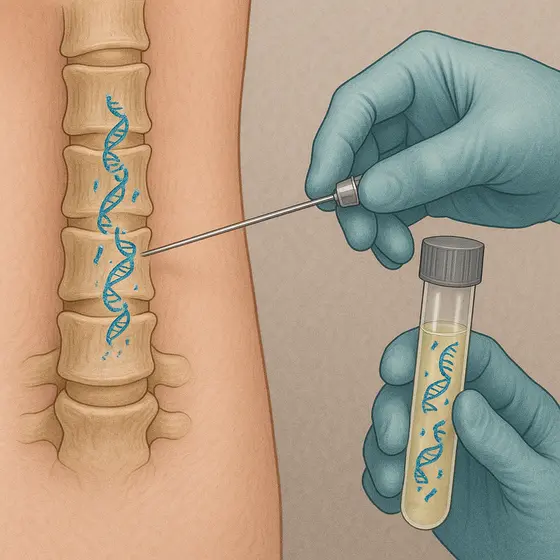
Usually, to find the right tumor treatment, a tissue sample has to be taken and analyzed, a tissue sample usually must be taken and analyzed. This can be particularly challenging in the case of brain tumors. “Especially in children, whose brains are still developing, we want to reduce such procedures to a minimum in the future. Sometimes the tumor is located in an area where only a tissue sample can be taken, but removal of the tumor is not possible,” says Kristian Pajtler, research group leader at the Hopp Children's Cancer Center Heidelberg (KiTZ), the German Cancer Research Center (DKFZ), and pediatric oncologist at the Heidelberg Medical Faculty of Heidelberg University (MFHD) at Heidelberg University Hospital (UKHD).
He and his colleague Kendra Maaß, research group leader at KiTZ and MFHD, have collaborated with international pediatric cancer centers, including St. Jude Children's Research Hospital in Memphis, USA, to develop the first high-precision method that can theoretically diagnose common brain tumors in children and adolescents without surgery.
The international research team developed an AI-based analysis of liquid biopsies. In a liquid biopsy, blood or cerebrospinal fluid is taken for analysis, depending on the type of cancer. The blood or cerebrospinal fluid of those affected contains, among other things, cell-free DNA from the cancer cells. However, because the amount of this tumor-derived DNA in cerebrospinal fluid is often very small, it has not yet been possible to establish a reliable brain cancer diagnosis using this method. In some advanced adult cancers, such as non-small cell lung cancer and colorectal cancer, liquid biopsies are already being used to monitor the course of the disease.
Precision diagnostics are particularly crucial in the case of tumors of the central nervous system (CNS): after blood cancer, these are among the most common types of cancer in childhood, and the entities are divided into more than 100 subtypes across all age groups. “Until now, molecular diagnostics based on liquid biopsies has not been an option for either children or adults with brain tumors. Due to the blood-brain barrier, DNA from brain tumors hardly enters the blood and very little genetic material is found in cerebrospinal fluid,” explains Kendra Maaß. For molecular diagnoses such as methylation analysis, which according to the World Health Organization (WHO) is now considered the gold standard for the classification of brain tumor tissue, the material from liquid biopsies has not been sufficient to date.
The authors of the study have now succeeded in processing the cell-free DNA from cerebrospinal fluid in such a way that the methylation signals on the tumor genome can still be reliably read for classification purposes. To achieve this, the researchers optimized a recently published new enzymatic sequencing technique for liquid biopsies. In addition, the team developed the new AI-based algorithm “M-PACT” specifically for the evaluation of liquid biopsies.
The AI-based method was evaluated using molecular data from 210 patient samples with ~20 subtypes of childhood brain tumors and a control panel of 58 non-malignant samples. The data was correlated with the patients' clinical data. As the present study shows, M-PACT can reliably diagnose brain tumors in children and adolescents with high specificity based solely on liquid biopsy data.
“The algorithm can also provide very accurate information on tumor burden and is therefore also suitable for monitoring the course of the disease,” says Kendra Maaß. “The method also detects when the number of certain disease-relevant genes are altered, which can be important biomarkers in some tumors. In addition, it indicates which other cell types release DNA in the cerebrospinal fluid. This could be important for immunotherapies in the future, for example.”
However, further clinical validation is necessary before the method can be used in clinical care. “We therefore hope that many international experts will now use the freely accessible AI in their research to analyze their liquid biopsy data,” says Tom Fischer, first author of the study from KiTZ, DKFZ, and UKHD. Kristian Pajtler adds: “Our diagnostic procedure could potentially eliminate some of the surgical procedures required for tissue sampling in the future. It could also be used to accurately diagnose tumors before surgery in order to recommend the most appropriate therapy as quickly as possible. However, regarding treatment in general, tumor surgery will remain an important pillar of cancer therapy.”
Original Publication:
K.S. Smith et al. M-PACT leverages cell-free DNA methylomes to achieve robust classification of pediatric brain tumors. In: Nature Cancer (Online Publication, February 17, 2026). DOI: 10.1038/s43018-026-01115-4
An Image for this press release is available for download at:
https://www.kitz-heidelberg.de/fileadmin/media/KiTZ-HD/News/2025/251203_Fluessigbiopsie-Liquor_c_ChatGPT.png
Caption:
Brain tumors can be precisely classified using cell-free DNA from cerebrospinal fluid.
Note on use of images related to press releases
Use is free of charge. The German Cancer Research Center (Deutsches Krebsforschungszentrum, DKFZ) permits one-time use in the context of reporting about the topic covered in the press release. Images have to be cited as follows: “Source: ChatGPT”.
Distribution of images to third parties is not permitted unless prior consent has been obtained from DKFZ’s Press Office (phone: ++49-(0)6221 42 2854, E-mail: presse(at)dkfz.de). Any commercial use is prohibited.


