The European Research Council funds basic research to advance particularly forward-looking projects and open up new interdisciplinary fields of knowledge. Each year, the Council awards “ERC Advanced Grants” to outstanding, established researchers in Europe; recipients are selected through a highly competitive process.
by Koh No. 32
ERC Advanced Grants for Dieter Saur and Aurelio Teleman
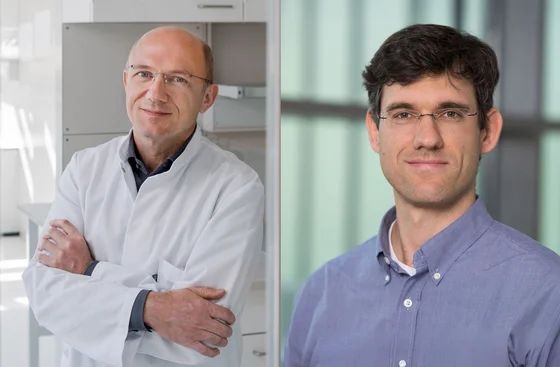
The European Research Council (ERC) supports visionary projects in basic research through its “Advanced Grants.” This year, the Council awarded a grant to cancer researcher and physician Dieter Saur from the DKTK Munich* site, who is investigating why immunotherapies against pancreatic cancer are often ineffective today and developing ways to make them more efficacious. Aurelio Teleman, a metabolism expert at the German Cancer Research Center (DKFZ), is tackling one of the fundamental questions of developmental biology with his ERC project: How do animals control their growth and size?

Immunotherapies are seen as a great hope in the fight against cancer, but their success is limited when it comes to pancreatic cancer. These tumors specifically suppress the body’s immune responses in their immediate vicinity. This is where Dieter Saur’s Evoke-PDAC project comes in. The initial goal is to better understand how different tumor variants build and utilize these “safe havens.”
To this end, Saur’s team is developing innovative models and methods that, for the first time, allow researchers to track with spatial and temporal precision how immune cells function within the tumor or are blocked. In a next step, Saur aims to develop new approaches that ensure immune cells attack the tumor and remain active over the long term. The results could lay the foundation for innovative therapies that improve the chances of survival for patients with this particularly aggressive form of cancer.
Dieter Saur is the DKTK Professor of Translational Tumor Research at the Technical University of Munich (TUM). His research has already been funded by an ERC Consolidator Grant.

Aurelio Telemann, a division head at DKFZ, is tackling one of the fundamental questions of developmental biology with his ERC project: How do animals control their growth and size?
It is known that a specific growth-promoting signaling pathway stimulates the growth of organisms depending on nutrient availability. Using the fruit fly Drosophila as a model, Teleman and his team have discovered that the small endogenous molecule adenosine counteracts the activity of this signaling pathway and thus inhibits the flies’ growth.
During food deprivation, the concentration of adenosine increases. Teleman aims to understand the molecular pathways through which adenosine mediates the effects of environmental signals on growth and metabolism: How exactly are adenosine levels regulated, and which tissues are involved? Through this research, he aims to expand our understanding of how animals establish a balance between growth-promoting and growth-inhibiting signals in response to environmental cues. He hypothesizes that these mechanisms are conserved in insects, by far the largest group of animals. It is even conceivable that adenosine plays a role in regulating growth in mammals as well. Teleman’s ERC project is intended to lay the groundwork for answering this question in the future.
Aurelio Teleman has already received funding from the ERC in the form of a Starting Grant and a Consolidator Grant.
* The DKTK is one of the eight German Centers for Health Research and connects the DKFZ with partner university sites throughout Germany.
Get in touch with us

Press Contact
About DKFZ
With more than 3,500 employees, the German Cancer Research Center (Deutsches Krebsforschungszentrum, DKFZ) is Germany’s largest biomedical research institute. DKFZ scientists identify cancer risk factors, investigate how cancer progresses and develop new cancer prevention strategies. They are also developing new methods to diagnose tumors more precisely and treat cancer patients more successfully. The DKFZ's Cancer Information Service (KID) provides patients, interested citizens and experts with individual answers to questions relating to cancer.
To transfer promising approaches from cancer research to the clinic and thus improve the prognosis of cancer patients, the DKFZ cooperates with excellent research institutions and university hospitals throughout Germany:
- National Center for Tumor Diseases (NCT, 6 sites)
- German Cancer Consortium (DKTK, 8 sites)
- Hopp Children's Cancer Center (KiTZ) Heidelberg
- Helmholtz Institute for Translational Oncology (HI-TRON Mainz) - A Helmholtz Institute of the DKFZ
- DKFZ-Hector Cancer Institute at the University Medical Center Mannheim
- National Cancer Prevention Center (jointly with German Cancer Aid)
The DKFZ is 90 percent financed by the Federal Ministry of Research, Technology and Space and 10 percent by the state of Baden-Württemberg. The DKFZ is a member of the Helmholtz Association of German Research Centers.


