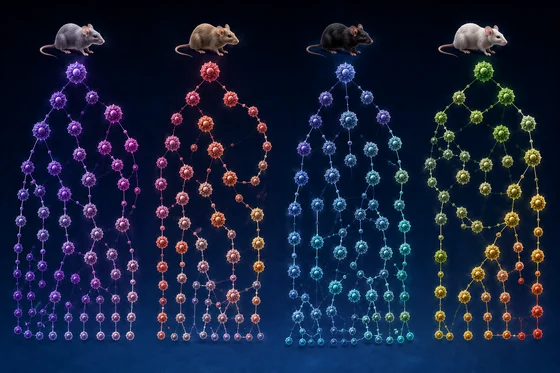
The study was led by researchers from the universities of Cambridge, Edinburgh, and Yale, as well as the DKFZ. The scientists examined over 580 liver tumors from four genetically distinct mouse strains. The genetic differences between the four strains roughly corresponded to the differences within the human population. All animals were kept under identical conditions and exposed to the same carcinogen, and yet the tumors developed in different ways depending on their genetic background.
Notably, despite their different pathways of origin, the tumors ultimately activated the same central signaling pathways—in particular, the so-called MAPK signaling pathway. This multistep cascade of molecular signals controls important life processes, including cell growth and cell differentiation, and plays a key role in numerous types of cancer. Many known cancer drivers, such as Braf or Kras, are persistently activated components of this pathway.
However, the genetic background influenced which mutations became established, how stable the tumor cells’ genome remained, and how quickly the cancer developed. There were significant differences in latency time among the four mouse strains, which, interestingly, did not correlate with the number or type of genetic changes.
Another striking observation was that, in one of the strains, fewer genetic changes were sufficient to induce malignant transformation of the cells and ensure the tumor’s survival than in the other three mouse lines.
The researchers have thus demonstrated for the first time, under strictly controlled conditions, how strongly the interaction between genetic predisposition and environmental factors determines the course of cancer development. The results suggest that even comparatively small differences in the genome can have significant effects on cancer risk, tumor biology, and possibly even response to therapies.
“Cancer does not arise entirely by chance. Although tumors often reach the same biological endpoint, the path to that endpoint is decisively determined by an individual’s genetic background. Here, we were able to demonstrate for the first time the extent to which genetic background influences both the mutation processes and the pathways leading to tumor development,” says Duncan T. Odom of the DKFZ, one of the study’s senior authors, adding: “This underscores how important it is to take genetic background into account when designing and interpreting biomedical and translational research. We therefore view our findings as an important long-term step toward even more precise, personalized cancer prevention, early detection, and treatment.”
Publication:
Sarah J. Aitken et al.: Genetic background sets the trajectory of experimental cancer evolution
Nature 2026, DOI: 10.1038/s41586-026-10821-z. https://www.nature.com/articles/s41586-026-10821-z.


