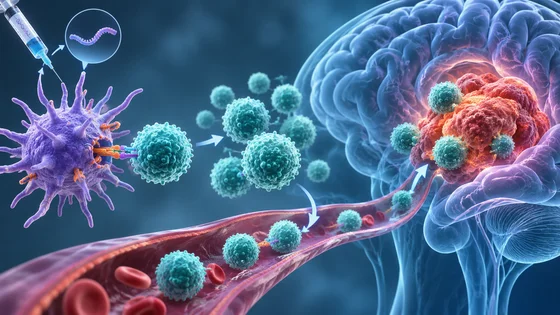

Glioblastomas are considered the most aggressive form of brain cancer. Despite surgery, radiation, and chemotherapy, the tumors often recur. High hopes are therefore pinned on immunotherapies that specifically activate the body’s own immune cells to attack cancer cells. However, such treatments have so far reached their limits, particularly when it comes to brain tumors: Too few of the therapeutic immune cells reach the tumor—and once there, they often lose their activity.
A research team led by Lukas Bunse (Head of the Neuro-Oncology Section at UMM and a scientist at the DKFZ) and Michael Platten (Director of the University Clinic for Neurology at UMM and Head of Department at the DKFZ) has now investigated how these obstacles can be overcome. Their idea: An mRNA vaccine targeting the tumor’s protein markers is intended to give the cancer-targeting therapeutic immune cells an extra boost.
A Booster for Tailored Immune Cells
The study focuses on a therapy using T cells that have been genetically engineered in the laboratory to express a specific recognition molecule. This so-called T-cell receptor enables them to recognize a specific feature of the tumor cells—much like an antenna—and to target the cancer. Experts refer to these as “T-cell receptor-transgenic T cells.” However, simply transferring the therapeutic immune cells to the patient is often not enough. Researchers must also ensure that the transgenic T-cells multiply in the body, remain active over the long term, and reach the tumor in sufficient numbers.
This is where the mRNA vaccination comes in. The mRNA provides another group of immune cells—dendritic cells—with instructions for producing a characteristic feature of the tumor. The dendritic cells then present a kind of “tumor profile” on their surface, which alerts the therapeutic T cells to the cancer’s characteristics. In this way, the vaccination acts as an amplifier for a cellular immunotherapy that is already specifically targeted against the tumor.
Immune cells proliferate massively and penetrate the brain more effectively
In mice with experimental glioblastomas, the combination of therapeutic TCR-T cells and mRNA vaccination showed remarkable efficacy: The transferred immune cells proliferated so extensively that at times they accounted for up to 80 percent of all killer T cells in the mice’s blood.
However, it was not just their number that was decisive; the vaccination also altered the properties of the therapeutic T cells. Thanks to this additional activation, more T cells were able to migrate into the brain tumors. Once there, they remained particularly effective at attacking the tumor and showed fewer signs of functional exhaustion.
This was reflected in the treatment’s success: While tumors continued to grow in untreated animals or those receiving low-dose monotherapy, the combination therapy was able to significantly slow tumor growth—in some cases, even in all animals in a given experimental series. The animals’ survival time also increased significantly.
Combination Therapy Also Effective Against Human Glioblastomas in a Mouse Model
To determine whether this principle could be applied to the treatment of patients with glioblastomas, the research team conducted experiments using human immune cells. These T cells were equipped with a receptor that specifically recognizes the PTPRZ1 protein. PTPRZ1 is present on human glioblastoma stem cells, which drive tumor growth.
The researchers tested the combination of PTPRZ1-specific therapeutic T cells plus mRNA enhancement both in cell experiments and in mice bearing human glioblastomas. The additional mRNA stimulation enhanced the ability of the therapeutic T cells to kill the human brain tumors. In some cases, the tumors in the animals regressed completely. However, the combination of the two approaches did not result in more severe side effects.
“The results provide us with important insights into how cell-based immunotherapies against brain tumors can be improved. In the long term, the combination could, for example, make it possible to use a lower initial dose of therapeutic T cells. This could potentially simplify the labor-intensive process of proliferating T cells in the laboratory,” says Andreas Dobbelstein, first author of the study.
“We are already preparing an initial clinical trial for the treatment of glioblastomas with PTPRZ1-targeted TCR-T cells. The combination with mRNA-based stimulation that we have now investigated could serve as a foundation for further clinical developments,” adds Lukas Bunse.
Michael Platten emphasizes, that the evaluation of the combination therapy is still in the preclinical research phase. “Whether the mRNA booster, in combination with cellular immunotherapy, is also safe and effective in patients must first be investigated in clinical trials.”
Publication
Andreas D. Dobbelstein, Yu-Chan Chih, Belize Acharya, Kuralay Aman, Vahid Khaki Bakhtiarvand, Alina Paul, Dennis A. Agardy, Clara Tejido, Patrick Wuchter, Özlem Türeci Ugur Sahin, Wolfgang Wick, Katharina Reinhard, Michael Platten, Lukas Bunse:
RNA vaccination drives expansion and brain-licensing of T cell receptor T cells in experimental glioblastoma.
Cancer Research 2026, DOI: 10.1158/0008-5472.CAN-26-0760
Institutional affiliations of the researchers involved in the publication:
- Medical Faculty Mannheim, University of Heidelberg
- Medical Faculty Heidelberg, University of Heidelberg
- Faculty of Life Sciences, University of Heidelberg
- Heidelberg University Hospital
- German Cancer Consortium (DKTK)
- NCT Heidelberg
- HI-TRON Mainz – a Helmholtz Institute of the DKFZ
- DKFZ Hector Cancer Institute at the University Medical Center Mannheim
- SynthImmune Cluster, University of Heidelberg
- BioNTech GmbH
- TRON gGmbH
- German Red Cross


