What makes the ERC’s “Proof of Concept” grants unique: Only those who are already receiving ERC funding can apply for these grants. The Research Council aims to enable scientists to explore and develop potential applications for the research results they have achieved in an ERC-funded project.
by Koh No. 33
Double ERC Success for DKFZ Researchers
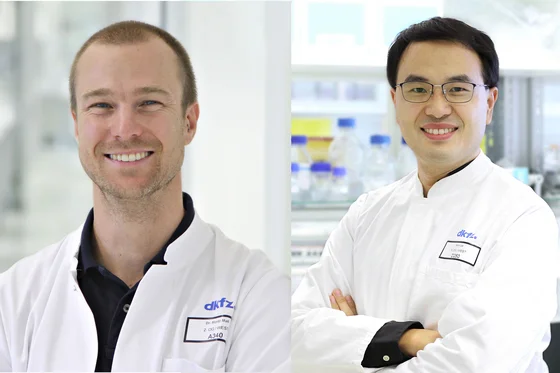
Through its “Proof of Concept” (PoC) grants, the European Research Council (ERC) supports scientists in further developing the economic potential of their research findings. In 2026, two scientists from the German Cancer Research Center (DKFZ) were once again selected to receive this prestigious funding: Moritz Mall is developing a gene therapy designed to make dangerous brain tumor cells sensitive to chemotherapy and radiation therapy. Chong Sun is able, for the first time, to observe in real time which cellular proteins interact with drugs – and aims to advance drug discovery with this approach.

Glioblastoma is considered the deadliest brain tumor; most therapies developed to treat this tumor fail in clinical trials. One reason for this is the “plasticity” of the tumor cells, which can switch between different states and thus evade treatment.
With the SafeCure project, Moritz Mall, a division head at DKFZ, is planning a completely novel form of gene therapy: He aims to equip glioblastoma cells with the neuronal transcription factor MYT1L. This factor serves as a guardian of cell identity and keeps glioblastoma cells in a stable state of low plasticity by suppressing alternative gene programs. As a result, the cancer cells should become sensitive to chemo- and radiation therapy persistently. Mall and his team call this a "lock-and-kill" strategy: MYT1L locks the cells in a vulnerable state, and chemotherapy and radiotherapy kill them.
To ensure that MYT1L, administered via gene therapy, acts exclusively in cancer cells, Mall and his colleagues have devised another innovation: Using AI, they were able to identify genetic enhancer elements that function only in cancer cells. The goal is to use these enhancers to specifically increase MYT1L activity in glioblastoma cells.
The technology behind SafeCure is protected by patents. The project is expected to culminate in an investor-ready preclinical package that will enable pharmaceutical companies to bring SafeCure to its first use in humans.

Clinical drug trials often fail because researchers today are unable to determine, across the entire spectrum of cellular proteins, which proteins a drug interacts with. As a result, interactions with unintended proteins often remain unnoticed, which can lead to serious side effects.
Chong Sun, who leads a junior research group at DKFZ, now aims to overcome this hurdle. With LIVEMAP, a novel technology that emerged from his ERC-funded research, it is now possible for the first time to map drug-binding proteins across the entire human proteome in living cells. Initial studies show that this technology can identify both established drug targets and previously unknown binding proteins across multiple drug classes.
In the newly approved ERC Proof-of-Concept project, Chong Sun plans to test the technology on additional drug classes, standardize and automate workflows, and assess market demand in collaboration with users from the pharmaceutical and biotechnology sectors. The goal is to establish a clear path for commercializing LIVEMAP by the end of the project, either through licensing or the founding of a spin-off.
Moritz Mall has been leading a research group since 2018 at the Hector Institute for Translational Brain Research (HITBR), a joint institution of DKFZ and the Central Institute for Mental Health (ZI) in Mannheim. The biologist completed his doctoral thesis at the EMBL in Heidelberg and subsequently conducted research at Stanford University in California.
Chong Sun began his studies in biotechnology in 2003 at Nanjing University of Science and Technology in China and completed them in 2010 with a master’s degree in pharmaceutical sciences from Utrecht University in the Netherlands. He then conducted research at the Netherlands Cancer Institute until 2019. Since November 2019, Chong Sun has led the “Cancer Immunoregulation” early-career research group at the DKFZ. The ERC previously supported Sun with a Starting Grant in 2022 and a first Proof-of-Concept (PoC) Grant in 2025.
Get in touch with us

Press Contact
About DKFZ
With more than 3,500 employees, the German Cancer Research Center (Deutsches Krebsforschungszentrum, DKFZ) is Germany’s largest biomedical research institute. DKFZ scientists identify cancer risk factors, investigate how cancer progresses and develop new cancer prevention strategies. They are also developing new methods to diagnose tumors more precisely and treat cancer patients more successfully. The DKFZ's Cancer Information Service (KID) provides patients, interested citizens and experts with individual answers to questions relating to cancer.
To transfer promising approaches from cancer research to the clinic and thus improve the prognosis of cancer patients, the DKFZ cooperates with excellent research institutions and university hospitals throughout Germany:
- National Center for Tumor Diseases (NCT, 6 sites)
- German Cancer Consortium (DKTK, 8 sites)
- Hopp Children's Cancer Center (KiTZ) Heidelberg
- Helmholtz Institute for Translational Oncology (HI-TRON Mainz) - A Helmholtz Institute of the DKFZ
- DKFZ-Hector Cancer Institute at the University Medical Center Mannheim
- National Cancer Prevention Center (jointly with German Cancer Aid)
The DKFZ is 90 percent financed by the Federal Ministry of Research, Technology and Space and 10 percent by the state of Baden-Württemberg. The DKFZ is a member of the Helmholtz Association of German Research Centers.


