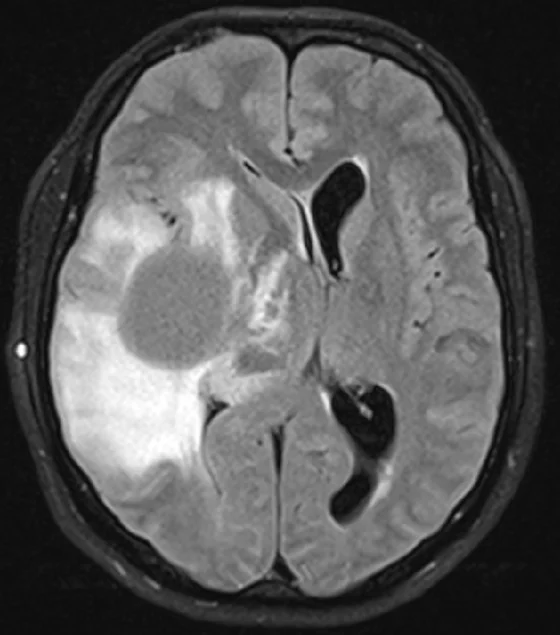
Gliomas are usually incurable brain tumors that are difficult to remove completely through surgery. Chemotherapy and radiation therapy are also only effective to a limited extent. These tumors often share a key characteristic: in the majority of cases, the cancer cells carry a common genetic mutation. An identical genetic error causes a specific amino acid to be substituted in the IDH1* enzyme. This results in a novel protein structure—a so-called neoepitope. What makes this special is that, on the one hand, the neoepitope drives tumor growth—and, at the same time, it is recognized as foreign by the patient’s immune system, making it an ideal target for immunotherapies.
The research team from Heidelberg/Mannheim and Tübingen has developed a peptide vaccine that specifically trains the immune system to recognize and fight tumor cells with this mutation. This vaccine was tested for safety and efficacy in a Phase 1 clinical trial (NOA 16) involving 33 patients with newly diagnosed high-grade astrocytomas, the most common form of glioma. The patients received the vaccine in addition to standard therapy consisting of surgery, radiation therapy, and chemotherapy.
Long-Term Survival Significantly Improved
The results after up to eight years of follow-up are remarkable: 66 percent of study participants were still alive after eight years, and in 42 percent of cases, the disease had not progressed during the observation period. Among some patients whose tumors could be completely removed surgically, survival rates were even significantly higher. By comparison: In earlier studies, the median survival time for more aggressive tumor types was often only about 2.5 to 5 years. In the current study, this threshold was significantly exceeded in many patients.
First author Lukas Bunse, head of the Neuro-Oncology Section at Mannheim University Medical Center and Scientist at the DKFZ, explains the key to the vaccine’s success: “The mutated IDH1 is an important tumor driver. The mutation appears early in tumor development and, crucially, remains stable even as the tumor cells evolve.”
The Immune System as the key to therapeutic success
A key finding of the study analysis is the link between the immune response and disease progression. Patients whose immune systems responded particularly well to the vaccine had significantly better long-term prognoses.
The vaccine activates two key components of the immune system: T cells, which directly attack infected or malignant cells, and B cells, which produce antibodies against the tumor. In particular, the long-lasting antibody response was associated with a favorable disease outcome.
The researchers also demonstrated that immune cells activated by the vaccine actually migrate into the tumor. In tissue samples, specific T cells were found only in those study participants whose tumors were under control—but not in those with rapidly progressing disease. This is considered an important indication that the therapy not only triggers an immune response in the blood but also acts directly within the tumor.
Booster shots could prolong the effect
Initial observations suggest that additional vaccine boosters can reinvigorate the immune response even years later—without causing additional side effects. This could help stabilize the therapy’s success over the long term in the future. “The Phase I clinical trial primarily examines safety and the immune response. Caution is warranted when drawing conclusions about efficacy, as the study lacks a control group. Nevertheless, the results provide strong evidence of clinical benefit,” says Lukas Bunse. “Based on the data we’ve collected, we’re now planning further studies to conclusively demonstrate the vaccine’s efficacy.”
Compared to other immunotherapeutic approaches, the vaccine developed by the research team has decisive advantages: Instead of developing individual vaccines for each patient, this therapy targets a common, tumor-specific mutation found in many patients. This means it could be used as a standardized immunotherapy for a larger group of patients. The vaccine can be combined with other modern therapies, such as immune checkpoint inhibitors or IDH enzyme inhibitors, which could further improve its efficacy.
“We are demonstrating here for the first time that a targeted vaccination strategy against a tumor mutation could lead to long-term survival benefits in brain tumors. This opens up a promising new avenue for treating cancers that have been difficult to treat until now,” summarizes Michael Platten, Director of the Department of Neurology at Mannheim University Medical Center and Head of Department at the DKFZ. “We are pleased that we can now test the efficacy of this promising therapeutic approach in a multicenter, randomized Phase 2 trial with funding from the National Center for Tumor Diseases.”
Lukas Bunse, Katharina Lindner, Antje Wick, Angelika Freitag, Lisa-Marie Lanz, Dominic Edelmann, Abigail Suwala, Michael O. Breckwoldt, Inga Harting, Felix Sahm, Richard F. Schlenk, Anita Schmitt, Oliver Schnell, Jörg Hense, Martin Misch, Dietmar Krex, Monika Denk, Juliane Walz, Joachim P. Steinbach, Andreas von Deimling, Michael Schmitt, Theresa Bunse, Ghazaleh Tabatabai, Martin Bendszus, Isabel Poschk, Wolfgang Wick, Michael Platten: Final analysis of patients with newly diagnosed astrocytoma after vaccination against mutant IDH1 from the NOA16 trial
Nature Cancer 2026, https://doi.org/10.1038/s43018-026-01199-y
* The following institutions were also involved in the study:
German Cancer Consortium (DKTK), Core Center Heidelberg
Heidelberg University Hospital
European Center for Neuro-Oncology
Tübingen University Hospital
NCT Trial Center
Charité University Hospital, Berlin
Essen University Hospital
Frankfurt University Hospital
Dresden University Hospital
Immune Monitoring Unit, National Center for Tumor Diseases (NCT), Heidelberg, Germany.


