The identity of cells is normally determined during embryonic development. They differentiate, for example, into nerve cells or liver cells and are thus permanently fixed. Only stem cells retain the ability to develop in different directions. Once differentiated, however, cells normally stay on course.
The situation is different with cancer cells. They are able to reactivate embryonic programs and thus change their identity. Scientists refer to this as plasticity. It gives tumor cells dangerous capabilities, such as breaking away from the cell cluster and migrating through the body. This plasticity is particularly pronounced in glioblastoma, the most malignant of all brain tumors, which contributes to treatment resistance and disease recurrence.
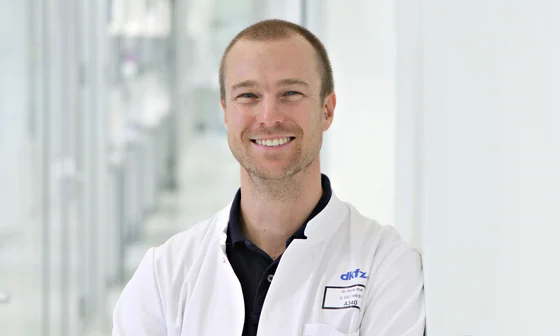
At the DKFZ and HITBR, Moritz Mall is investigating ways to limit the plasticity of cancer cells and thus prevent the spread of malignant tumors.
Normally, a sophisticated control network governs a cell’s identity. In this process, so-called master regulators activate groups of genes, under whose influence the characteristic properties of specialized cells develop. Moritz Mall was one of the first to recognize that cell identity is not maintained by the activation of specific gene groups—but rather, on the contrary, by the active suppression of alternative genetic programs.
The antagonists of the master regulators, which prevent the (re)differentiation of differentiated cells, act as guardians of cell identity. As repressors, they switch off specific gene programs. In glioblastoma, little is known so far about the identity of such “guardians.” With the project funded by the Sibylle Assmus Prize, Moritz Mall now aims to identify repressors that stabilize brain tumor cells in a state of low plasticity.
Using single-cell analyses and AI-supported modeling, he and his team have already identified several candidates. He now intends to functionally characterize these potential “guardians” and thereby identify repressors that most effectively limit the plasticity of glioblastoma cells. In doing so, Moritz Mall is taking the first step toward a completely novel approach that may one day allow for better management of difficult-to-treat oncological diseases such as glioblastoma.
Mall did his doctoral research at the European Molecular Biology Laboratory in Heidelberg and received his Ph.D. from the Swiss Federal Institute of Technology Zurich in 2011. He subsequently continued his research at the Stanford University School of Medicine. Since 2018, Moritz Mall has led the junior research group (to become a division in 2025) “Engineering of Cell Identities and Disease Models” at the Hector Institute for Translational Brain Research, a joint project of the DKFZ and the Central Institute of Mental Health in Mannheim supported by the Hector Foundation II.
The Sibylle Assmus Foundation awards the Sibylle Assmus Research Grant for oncological research with a focus on neuro-oncology and neurobiology. The grant is intended to support the work of early-career scientists and helps to fund research projects and study visits. The grant is awarded for outstanding achievements by researchers who have contributed to the understanding of cancer development or to new diagnostic or therapeutic approaches.
The Sibylle Assmus Research Award for Neuro-Oncology is endowed with €15,000 and will be presented on May 7 at the annual meeting of the Neuro-Oncology Working Group of the German Cancer Society (Deutsche Krebsgesellschaft e.V.) in Regensburg.


