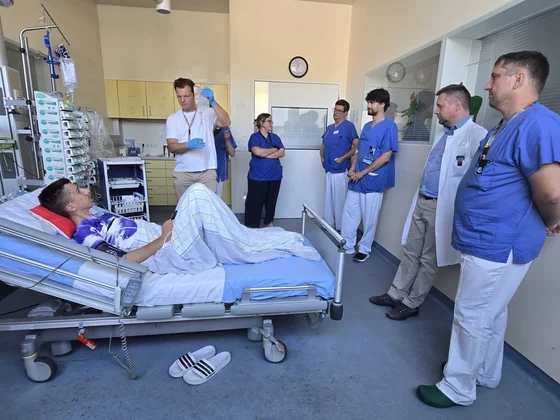
The patient developed a kidney tumor (nephroblastoma) at the age of seven and experienced numerous relapses with metastases over a period of ten years. At the time of treatment, the disease was far advanced: large tumor lesions in the abdominal cavity, numerous metastases in the lungs, liver and pelvis, as well as a brain metastasis defined the clinical picture. No curative treatment options or suitable clinical trials were still available.
Molecular tumor analyses performed as part of the INFORM tumor sequencing program showed that the cancer cells produced the tumor antigen PRAME ("Preferentially Expressed Antigen in Melanoma"). "PRAME is well described as a target structure for immunotherapies in adult cancers, for example malignant melanoma. Our decision to offer the treatment attempt despite the far advanced disease was based on highly promising clinical data from our collaboration partner Immatics, a biotechnology company based in Tübingen. In clinical trials in adults, impressive treatment successes have already been achieved with PRAME-specific T cells," reports Christian Seitz, the treating physician and medical director of stem cell transplantation, cell and gene therapy at the Hopp Children's Cancer Center Heidelberg (KiTZ) and Heidelberg University Hospital (UKHD), as well as a scientist at the German Cancer Research Center (DKFZ).
For the therapy, the patient's own T cells were genetically modified by the team led by Patrick Schmidt in the laboratory at the National Center for Tumor Diseases (NCT) Heidelberg so that they could recognize PRAME and specifically attack the cancer cells. The vector required for this, containing the genetic instructions for reprogramming the T cells, was provided by the Tübingen-based collaboration partner Immatics. The patient received the locally manufactured cells in July 2025 after a seven-day manufacturing process as an infusion.
Just nine days later, a tumor biopsy showed massive infiltration of the T cells into the tumor tissue as well as the death of tumor cells. In the following weeks and months, the tumor disease continued to regress in all affected organs. In a further biopsy, three months after treatment, no living tumor cells could be detected. Additional imaging examinations and blood tests currently show no evidence of active cancer. "At the present time, almost one year after the infusion of the T cells, our patient is in excellent condition. He trains regularly, takes part in cycling races, was able to successfully complete his vocational training, and now plans to obtain his Abitur," confirms Christian Seitz. "The case impressively demonstrates the potential that innovative immunotherapies can unfold for children and adolescents with previously incurable tumor diseases. At the same time, it highlights the importance of partnership-based collaboration between the biotechnology industry and academic translation for the development of new therapeutic approaches. We extend our heartfelt thanks to Immatics, whose provision of the vector made it possible to carry out this individual compassionate-use treatment."
At KiTZ Heidelberg, a first Phase I/II clinical trial for children and adolescents with PRAME-positive solid tumors is currently being prepared under the name "PRAMEtime". The patients' own genetically modified immune cells will be produced and provided by Immatics.
In total, up to 18 children and adolescents aged eight to 17 are to be enrolled in "PRAMEtime". The start of the trial is planned for 2027. "Tumor data from more than 2,500 patients from our INFORM study show that this protein occurs in many high-risk tumors in children and adolescents and therefore represents a promising target for new therapies," explains Olaf Witt, co-lead of the clinical trial and Director of KiTZ. Olaf Witt is also Professor at the Heidelberg Medical Faculty of Heidelberg University, heads the Clinical Cooperation Unit Pediatric Oncology at the DKFZ, and is a senior consultant at UKHD.
The "PRAMEtime" study is being funded by the Dietmar Hopp Foundation with around 1.8 million euros over a period of four years at the Heidelberg Medical Faculty of Heidelberg University. "Because patient numbers are small, new treatment approaches for children with cancer are primarily brought into early clinical trials by academic research institutions. Without private research funding, this is often not possible, and we are therefore deeply grateful to the Dietmar Hopp Foundation for supporting our work," says study leader Christian Seitz.
Original publication:
K. Mair et al.: PRAME-Specific T-Cell Therapy in Advanced Pediatric Nephroblastoma. In: New England Journal of Medicine. (Online publication 13th of August 2026). DOI: 10.1056/NEJMc2605154
Images are here available for download:
Image 1
Image 2
Captions:
Image 1:
The then 17-year-old Mailo receives T-cell therapy against PRAME with his genetically modified immune cells in July 2025.
Image 2:
Since the beginning of this year, Mailo has once again been training weekly on his mountain bike and taking part in competitions. Here at the Bike Festival in Riva del Garda in May 2026 (Instagram: @mailo.grh).
Usage note for image material accompanying press releases
Use is free of charge. The German Cancer Research Center (DKFZ) permits one-time use in connection with reporting on the subject of the press release or on the DKFZ in general. Please provide the following image credits: "Source Image 1: private; Source Image 2: @mailo.grh".
The image material may only be passed on to third parties after prior consultation with the DKFZ Press Office (Tel. +49 6221 42 2854, email: presse(at)dkfz.de). Use for commercial purposes is prohibited.
The Hopp Children's Cancer Center Heidelberg (KiTZ)
The "Hopp Children's Cancer Center Heidelberg" (KiTZ) is a pediatric oncology institution of the German Cancer Research Center, Heidelberg University Hospital, and Heidelberg University. Like the National Center for Tumor Diseases (NCT) Heidelberg, which focuses on adult oncology, KiTZ is modeled in structure and concept on the U.S. model of so-called "Comprehensive Cancer Centers" (CCC). KiTZ is both a treatment and research center for oncological and hematological diseases in children and adolescents. Its goal is to scientifically investigate the biology of childhood cancers and severe blood disorders and to closely link promising research approaches with patient care - from diagnosis and treatment through to follow-up care. Children with cancer, especially those for whom no established treatment options are available, receive an individual treatment plan at KiTZ, developed jointly by experts from various disciplines in tumor boards. Many young patients are able to participate in clinical trials and thus gain access to new treatment options. In translating research findings from the laboratory into the clinic, KiTZ therefore plays a pioneering role.


