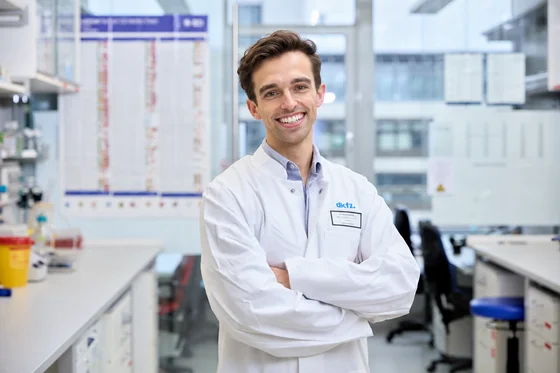
Mirco Friedrich leads a junior research group at the DKFZ and is a physician at the University Clinic for Hematology, Oncology, and Rheumatology in Heidelberg. In recent years, his research has focused primarily on the aging immune system. As we age, the body’s immune defenses gradually decline. At the same time, however, many types of cancer are typical age-related diseases, and all cancer immunotherapies rely on a functioning immune system.
Friedrich demonstrated in mice that the aging process of the immune system can be reversed: By administering specific mRNAs, the animals were able to produce three signaling molecules that rejuvenated their immune systems. As a result, vaccinations became more effective, and even older animals were able to reject tumors. An initial clinical trial to determine whether this effect can also benefit patients with blood cancers is currently in preparation.
In another research project, Friedrich explained why immunotherapies often fail to work in cases of blood cancers such as multiple myeloma or acute leukemia: The immune cells in the bone marrow that target the tumor are often not exhausted, as was long assumed, but merely dormant and can therefore be activated. Using a test developed by Friedrich’s team, it is now possible to predict, based on a blood sample, who will benefit from immunotherapy and who will not.
The treatment of blood cancers is also the focus of HemaGuide, a clinical AI system developed by Friedrich and his team that supports doctors in their decision-making. HemaGuide was trained using data from over 2,000 real-world cases and, based on this, makes individualized treatment recommendations for cancer patients that align with the decisions of experienced medical teams and interdisciplinary tumor boards more than 80 percent of the time. This platform is currently being further developed in collaboration with several German university hospitals to broadly integrate university medical expertise and the latest treatment options into patient care with the help of HemaGuide.
Mirco Julian Friedrich has been a research group leader at the DKFZ and HI-STEM gGmbH since 2025 and is a practicing hematologist and oncologist at Heidelberg University Hospital. After completing his medical degree and Ph.D. in Heidelberg and at Harvard Medical School, he was a postdoctoral fellow and EMBO Fellow at the Massachusetts Institute of Technology (MIT). He has published his research findings in leading international journals such as *Nature*, *Nature Medicine*, and *Cancer Cell*.
Friedrich has already received numerous awards for his research, including the Forbes 30 Under 30 - Europe, the MIT McGovern Technology Award, the DGHO Doctoral Prize and the Vincenz Czerny Prize, Young Investigator Awards from the American societies for Neuro-Oncology (SNO) and Multiple Myeloma Research (IMS), as well as the 2025 Kind-Philipp Research Prize.
The Peter and Traudl Engelhorn Foundation supports early-career researchers in the life sciences in Germany, Austria, and Switzerland. To this end, the foundation primarily awards postdoctoral fellowships to outstanding early-career researchers. In addition, every two years, it honors young scientists who have achieved outstanding success in a current field of research with the Peter and Traudl Engelhorn Foundation Research Prize, which is endowed with 10,000 euros.
*The Heidelberg Institute for Stem Cell Technology and Experimental Medicine (HI-STEM) gGmbH was founded in 2008 as a public-private partnership between the DKFZ and the Dietmar Hopp Foundation.
A photo of Mirco Friedrich is here available for download.
Terms of Use: Use is free of charge. The German Cancer Research Center (DKFZ) permits one-time use in connection with reporting on the topic of the press release or on the DKFZ in general. Please provide the following image credit: Friedrich/DKFZ
Distribution of the images to third parties is permitted only after prior consultation with the DKFZ Press Office (Tel. 06221 42 2854, Email: presse@dkfz.de). Use for commercial purposes is prohibited.


