Inflammation plays a central role in defending against pathogens, repairing tissue, and healing wounds. A large number of genes are involved in an inflammatory response. They ensure that cytokines are released, immune cells are activated, and blood vessels become more permeable. The activation of these genes, which is largely controlled by tumor necrosis factor (TNF), is a constant balancing act for the cell: if it is too weak, the body cannot effectively fight infections. If activation is too strong or lasts too long, there is a risk of chronic inflammation, tissue damage, autoimmune diseases, or cancer. This makes it all the more important for cells to regulate inflammatory genes at exactly the right time and to the right degree.
Researchers at the German Cancer Research Center (DKFZ) and Heidelberg University have now shown that cells use two different strategies for this purpose, which they also combine. Using human vascular cells, the team was able to trace how around 1,500 different TNF-induced inflammatory genes are switched on in a controlled manner after an inflammatory stimulus.
Some of these genes are regulated via loose, short-lived contacts in the genome. A kind of DNA loop formation temporarily brings the target gene to be activated and distant regulatory DNA segments together spatially. These contacts are not stable and quickly dissolve again. They enable finely tuned and flexible control of individual genes, especially those that are activated later or only in some of the cells.
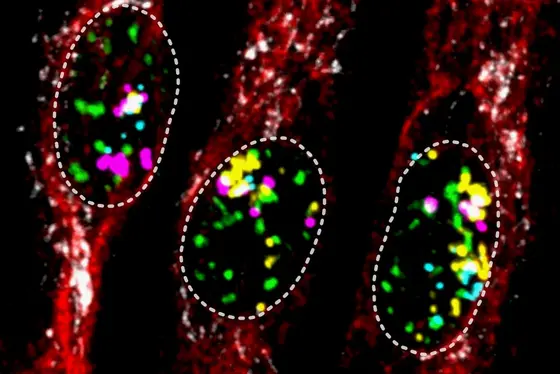
In addition, the Heidelberg team identified control centers in the cell nucleus. In these areas, many regulatory proteins, known as transcription factors, dock close together on the DNA. The inflammatory genes are often located in clusters and are activated together. Such control centers allow for rapid, strong, and coordinated activation of genes—ideal for a rapid inflammatory response when the body needs to react immediately.
“Inflammation is not switched on and off like a toggle switch, but is a finely modulated process,” says study leader Karsten Rippe from the DKFZ. "Through the interaction of both mechanisms, the cell can precisely initiate, amplify, and later dampen inflammatory responses. The switching centers enable a rapid initial response, while the loose contacts ensure targeted fine-tuning as the process continues."
The results provide an important basis for better understanding misdirected inflammatory processes—for example, in chronic inflammatory diseases or cancer—and possibly developing more targeted therapeutic approaches in the long term.
Isabelle Seufert, Irene Gerosa, Vassiliki Varamogianni-Mamatsi, Anastasiya Vladimirova, Ezgi Sen, Stefanie Mantz, Anne Rademacher, Sabrina Schumacher, Panagiotis Liakopoulos, Petros Kolovos, Simon Anders, Jan-Philipp Mallm, Argyris Papantonis & Karsten Rippe: Two distinct chromatin modules regulate proinflammatory gene expression
Nature Cell Biology 2025, https://doi.org/10.1038/s41556-025-01819-2


