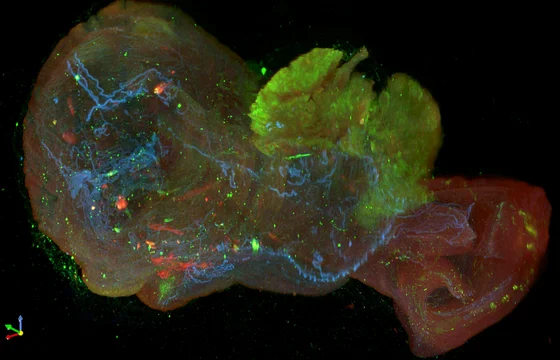
Approximately 55,000 people are diagnosed with colorectal cancer in Germany each year. About a quarter of these cases develop from a specific type of colorectal polyp (so-called serrated lesions). These precursor lesions often carry a mutation in the BRAF gene and lead to particularly aggressive tumors that respond poorly to existing therapies.
Until now, the molecular changes leading to the development of this subgroup of colorectal cancer and the factors behind its aggressiveness were only partially understood.
WNT Activation Starts the Process
The team led by René Jackstadt at the DKFZ and HI-STEM has now demonstrated that activation of the WNT signaling pathway triggers the malignant transformation and ultimately leads to tumor development. WNT is a key signaling pathway in cells that controls growth, cell division, and tissue development. Using genetically modified mice, organoid models, and modern single-cell analyses, the researchers investigated how WNT activation affects the cellular composition of the tumor microenvironment during the malignant transformation of the precursor lesion. In the process, they observed a profound remodeling of the tumor microenvironment
A suppressed immune system is the key factor
The focus was on the signaling molecule CCL20, which is known to attract immune cells. However, WNT-activated tumor cells produce significantly less CCL20. As a result, fewer immune cells enter the tumor, making it easier for the cancer cells to evade the body’s immune defenses. In the experimental models, restoring CCL20 production led to a significant slowdown in tumor growth.
“The results show how closely individual gene mutations are linked to the functioning of the immune system. We now have an explanation for how BRAF-mutated colorectal tumors evade the immune system—this is the first step toward understanding the particular aggressiveness of this form of cancer,” explains research leader Jackstadt.
At the same time, the results identify the WNT signaling pathway as a potential target for future treatment strategies. Although various WNT inhibitors are already in clinical development, no drug in this class has yet been approved for cancer treatment. Combination therapies that combine inhibition of the WNT signaling pathway with immunological approaches could also be promising. However, further preclinical and clinical studies are needed to determine whether these approaches will prove effective in clinical practice.
*The Heidelberg Institute for Stem Cell Technology and Experimental Medicine (HI-STEM) gGmbH was founded in 2008 as a public-private partnership between the DKFZ and the Dietmar Hopp Foundation.
Manuel Mastel, Aitana Guiseris Martinez, Umberto Pozza, Jasmin Meier, Ioannis Chiotakakos, Sandra Jaun, Carolin Artmann, Gabriele Diamante, Nikolaos Georgakopoulos, Philipp Albrecht, Yvonne Petersen, Saskia Reuter, Barbara Schmitt, Michael Günther, Alexandra Thiran, Istiffa Nurfauziah, Ian Ghezzi, Kyanna S. Ouyang, Michael D. Milsom, Jens Puschhof, Nic G. Reitsam, Kim E. Boonekamp, Johannes Betge, Steffen Ormanns, Michael Boutros, Rene Jackstadt: WNT-driven immune evasion promotes malignant transformation of BRAF-mutant colorectal cancer.
Gastroenterology 2026, DOI: 10.1053/j.gastro.2026.07.035


