Functional
Genome Analysis (B070)
Deutsches
Krebsforschungszentrum,
Im Neuenheimer Feld 580
D-69120
Heidelberg,
Germany. |
 |
.
.
..
..
...
..
..
FINISHED
PROJECT:
GHSR
DNA
hypermethylation: a common epigenetic alteration of high diagnostic
value
in many cancers


|
|
Diagnosis
Identification
of a single
molecular trait that is determinant of common malignancies may serve as
a
powerful diagnostic supplement to cancer type-specific markers.
Substantial
hypermethylation at the promoter and first exon of growth hormone
secretagouge
receptor (GHSR) was found to be characteristic of seven studied
malignancies
with very high sensitivity and specificity. Discrimination of breast or
pancreatic cancer from healthy tissue samples exhibited 100%
specificity and
sensitivity, for example.
...
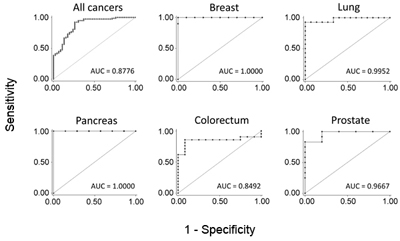
Figure to the right: Typical ROC
diagrames are
shown for five particular cancer entities. Also the overall accuracy
for all
studied cancers is presented. The AUC value indicates the respetive
degree of diagnostic accuracy.
Early detection
Moreover,
differential methylation
was observed for ductal carcinoma in situ (DCIS), for instance, which
is
considered an early stage breast cancer that may progress to invasive
cancer. GHSR
gene methylation could therefore be particularly attractive for early
detection, which is a key factor in cancer control.
|
|
|
|
|
|
|
|
|
|
Field defect in sporadic cancers
The
increased methylation of the signature
CpGs was also present in normal-appearing tissues collected from cancer
patients, but not in samples obtained from healthy donors. This
suggests the
involvement of DNA methylation in a “field defect”. Field defect (or
field
cancerization) refers clinically to the existence of pre-neoplastic
alterations
in cells of a tissue that are associated with local recurrences. From a
molecular point of view, this phenomenon has been explained by genetic
abnormalities in patients with familial cancers. However, our data
propose a
contribution of epigenetic alterations to the field defect in sporadic
cancers.
GHSR methylation could thus possibly act as a marker of treatment
success and
recurrence.
...
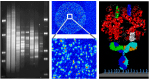
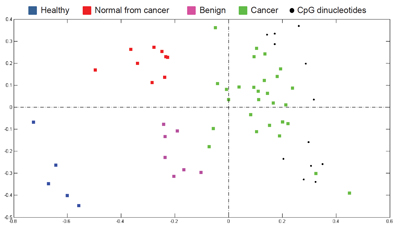
Figure to the left: To
visualise differences in the degree of methylation in breast samples,
correspondence
analysis (CA) was used. In the projection plot, each sample is depicted
as a
coloured square and CpG sites that exhibited the most significant
differential
methylation levels are represented as black dots. All co-localise with
the cancer
samples at the right side of the plot, indicating that the highest
methylation level
is found in cancer. In contrast, the healthy samples are located to the
left, in
the opposite direction off the centroid, indicating that the CpGs are
at the
lowest level of methylation in these samples. Likewise, based on the
localisation
of normal-appearing tissues of cancer patients and benign samples along
the
horizontal axis (first principal component; i.e., the direction along
which the
samples show the largest variation), it can be seen that an
intermediate
methylation load existed in these samples
|
|
|
Amini et al. (2019) J. Cell. Physiol., in press. 
Jandaghi et al. (2015)
Cell Cycle 14, 689. |
|
.
Moskalev et al. (2015) Oncotarget 6,
4418.
Botla et al. (2012) Breat Cancer Res. Treat.
136, 705. |
..
..
..
..
.
..
.
...
|
FINISHED
PROJECT:
Correction of
PCR-bias in quantitative DNA-methylation studies
PCR
amplification of bisulfite-treated DNA is a processing step that is
common to
many currently used methods of quantitative methylation analysis.
Preferential
amplification of unmethylated alleles – known as PCR-bias – may
significantly
affect the accuracy of quantification. To date, reported processes for
avoiding
PCR-bias relied on an optimisation of PCR conditions. Although shown to
be
effective for particular genes, the implementation is time-consuming
and
labour-intensive, especially if multiple loci are analysed, thus the
usefulness
remains contradictory.
...
We developed an
effective method of correcting biased methylation data. As opposed to refining experimental conditions,
we approached the correction of amplification bias by accepting its
occurrence
during experimentation but adjusting the initial amplification result
by a
comparison to calibration data and the application of regression curves for deriving correction factors. As few as three calibration samples (0, 50, 100% methylation)
are sufficient to define methylation degrees accurately. Two types of regression – hyperbolic and cubic
polynomial – were checked. The correction process based on cubic polynomial regression was found to be
superior overall.
...
The method is
applicable irrespective of the locus
that is interrogated or the number of sites analysed. Based on curve-fitting, the method is not influenced by
the type of bias – preferential recovery of methylated or
unmethylated alleles – and works equally
well for both. Furthermore, any bias that
was additionally introduced by the analysis procedure, for example a
sequencing readout, could be compensated by the very process. The
method is
also automatable for high-throughput analyses.
...
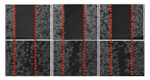
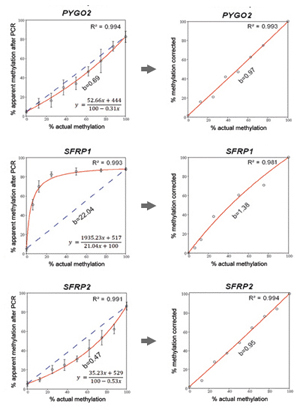
Figure legend: The
degree of bias introduced by PCR-amplification is shown for three gene
promoters.The apparent degree of methylation observed after
amplification (y axis) was plotted as a function of the actual
methylation (x axis). The red line indicates the regression curve
fitted to the data. Without correction (left)
there was partly a
substantial deviation between real and observed methylation, as
indicated by the distance between the red line and the expected
diagonal. The deviation basically disappeared upon correction (right).
Kapsner et al. (2021) Int. J. Cancer 149, 1150-1165.
Moskalev et
al. (2011) Nucleic Acids Res. 39, e77. 
|
|
|
...
|
|
FINISHED PROJECT:
Epigenetically
de-regulated miR-375 is involved in a positive feedback loop with
Estrogen Receptor alpha in breast cancer cells

Breast cancer is the
leading cause of cancer death in women worldwide. Although it is a
heterogeneous disease, two-thirds of breast cancers share the common
feature of
being dependent on the presence and interaction of estrogen with the
nuclear
Estrogen Receptor α (ERα) protein. Approximately 70% of
invasive breast cancers express ERα in actively proliferating cells.
...
It
has
become evident that ERα is up-regulated in luminal mammary epithelial
cells
during early stages of tumorigenesis and its overexpression is an
important
stimulatory factor for proliferation
of mammary cells, leading to cell division and eventually to tumor
development. The obvious role of ERα
signalling in orchestrating the expression of genes involved in
growth-related
pathways, has established ERα as an important therapeutic target in
breast
cancer treatment. However, our understanding of the molecular
mechanisms
underlying deregulation of this signaling pathway is scarce.
...
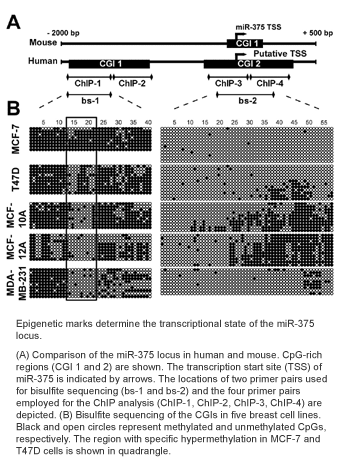
We identified a high
expression of microRNA 375 (miR-375) in ERα-positive cell lines.
miR-375
overexpression is mainly caused by the loss of epigenetic marks, such
as
H3K9me2 and local DNA hypomethylation, which, in turn, triggers the
dissociation of the transcriptional repressor CTCF from the promoter
and
enables interactions of ERα with regulatory regions of miR-375.
Inhibition of
miR-375 in ERα positive MCF-7 cells results in reduced ERα activation
and cell
proliferation.
...
A combination of expression profiling from tumour samples
and
miRNA target prediction identified RASD1 as a potential miR-375 target.
Our
findings show that miR-375 regulates RASD1 through targeting its 3'
UTR. In
addition, we demonstrated that RASD1 negatively regulates ERα
expression. Our
data indicate the existence of a positive regulation between ERα and
miR-375
and suggest new strategies for the treatment of ER-positive invasive
breast
tumours.
...
Further
analyses are under way to add more regulative mechanisms involved in
the overall process.
de Soza Rocha Simonini et
al. (2010) Cancer Res. 70, 9175-9184.
|
FINISHED PROJECT:
Systematic
Methological Platform Epigenetics |
|
|
 As
part of the National German Research
Network (NGFN), we applied
microarray
and sequencing technology toward a genome-wide and at the same time
high-resolution
analysis of DNA
methylation
patterns.
...
The
group
assembled in this platform had established the means for (1) the sodium
bisulfite modification of DNA samples for the generation of
methylation dependent polymorphisms, (2) the detection of the resulting
single-base polymorphisms on complex oligonucleotide microarrays or by
sequencing processes and
(3) bioinformatics
platforms for subsequent data analysis, with a special focus on
combining the
epigenetic information with transcript profiles and clinical
information. Also,
clinical material with
corresponding
clinico-pathological information was available for the analyses
performed within the platform. As
part of the National German Research
Network (NGFN), we applied
microarray
and sequencing technology toward a genome-wide and at the same time
high-resolution
analysis of DNA
methylation
patterns.
...
The
group
assembled in this platform had established the means for (1) the sodium
bisulfite modification of DNA samples for the generation of
methylation dependent polymorphisms, (2) the detection of the resulting
single-base polymorphisms on complex oligonucleotide microarrays or by
sequencing processes and
(3) bioinformatics
platforms for subsequent data analysis, with a special focus on
combining the
epigenetic information with transcript profiles and clinical
information. Also,
clinical material with
corresponding
clinico-pathological information was available for the analyses
performed within the platform.
...
Infrastructure
was provided for collaborations within the NGFN-network and
beyond. Different systems were provided, which met the
requirements of the respective
project.
By comparisons between them, also standards were
defined that allow comparability of data across platforms and
various areas of analysis. Also for this purpose, the close
connection
and integration of the consortium with international partners was
crucial.
The
platform combined groups with complementary but nevertheless
sufficiently
overlapping expertise, competence and capability. Parallel to data
production and a biological, functionally oriented interpretation, the
resulting information was used for biomedical applications. In
addition, technical developments were
performed in
order to improve quality and reliability.
...
The
results from the platform's activities were: (1)
definition
and establishment of standards for epigenetic analyses on microarray
systems; evaluation and comparison to other systems via external
networking; (2)
establishment
of genome-wide microarrays for a global analysis of disease-relevant
variations
in methylation; (3) identification
of disease-specific markers or patterns for diagnosis and prognosis;
(4) identification
of methylation patterns that are indicative for the action of drugs
(clinical
and commercial utilisation by the respective platform- and
NGFN-partners). In terms of
tumour entities, there was a focus on
chronic
lymphocytic leukemia,
melanoma, pancreatic and breast cancer.
...
Specific results were a process for the correction
of experimental
biases during the
measurement of methylation, methylation patterns closely
associated with the occurance of pancreatic cancer as well as the
elucidation of functional mechanisms in breast and pancreatic cancer.
|
de Soza Rocha Simonini et
al. (2010) Cancer Res. 11, 162-167.
Moskalev et al. (2011) Nucleic Acids Res. 39, e77.
Moskalev et
al. (2012) Genes
Chrom. Cancer 51, 105-110. |
|
|
|
|
|
Jörg
Hoheisel (coordinator) |
DKFZ, Heidelberg |
... |
Methodical
analysis of the
methylation sites in chromosome 21:
|
|
|
|
|
Frank
Lyko |
DKFZ, Heidelberg |
|
|
|
|
|
Hermann-Josef
Gröne |
DKFZ, Heidelberg |
|
.. |
Jörn
Walter |
Universität
Saarbrücken |
|
|
|
|
Andreas
Waha |
Universität
Bonn |
|
|
Albert
Jeltsch |
Internationale
Universität
Bremen |
|
|
|
|
Matthias
Schuster |
Epigenomics,
Berlin |
|
|
Richard
Reinhard |
Max-Planck-Institut
für Molekulare Genetik, Berlin |
|
|
|
|
Peer
Stähler |
febit
biotech,
Heidelberg |
|
|
Matthias
Platzer |
Leibniz Institut
für Altersforschung, Jena |
|
|
|
|
|
...
FINISHED PROJECT:
High definition
profiles of drug-resistent breast and ovarian carcinoma

Acquired
drug resistance represents a frequent
obstacle which hampers efficient chemotherapy of cancers. Hence,
treatment
via standardised chemotherapy fails in a large fraction of patients,
making
additional therapy regimens necessary. In order to minimise
side-effects caused
by ineffective chemotherapy, prediction of individual patients’
response to
therapeutic agents before the commencement of treatment would be
desirable. The
contribution of
aberrant DNA methylation to the development of drug resistant tumour
cells has
gained increasing attention over the past decades. Hence, the objective
of this
study was to characterise DNA methylation changes which arise from
treatment of tumour cells with the chemotherapeutic drug doxorubicin.
...
DNA
methylation levels from CpG islands (CGIs) linked to twenty-eight genes
were
analysed,
whose
expression levels had previously been shown to contribute to resistance
against
DNA double strand break inducing drugs or tumor progression in
different cancer
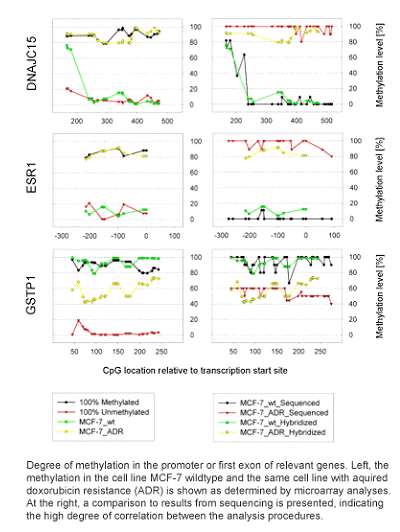
types. High-definition DNA methylation profiles which consisted
of methylation levels from 800 CpG sites mapping to CGIs around the
transcription start sites of the selected genes were determined. In
order to
investigate the influence of CGI methylation on the expression of
associated
genes, their mRNA levels were investigated via qRT-PCR. It was shown
that the
employed method is suitable for providing highly accurate methylation
profiles,
comparable to those obtained via clone sequencing, the gold standard
for
high-definition DNA methylation studies.
...
In
breast
carcinoma cells with
acquired resistance against the double strand break inducing drug
doxorubicin,
changes in methylation of specific cytosines from CGIs linked to
thirteen genes
were detected. Moreover, similarities between methylation profiles
obtained from
breast and ovarian carcinoma cell lines with acquired doxorubicin
resistance
were found. The expression levels of a subset of analysed genes were
shown to
be linked to the methylation levels of the analyzed CGIs.
...
Our
results
provide
detailed DNA methylation information from two separate model systems
for
acquired doxorubicin resistance and suggest the occurrence of similar
methylation changes in both systems upon exposure to the drug. This
collaborative effort is being continued with the aim of stratification
of patients prior to treatment dicisions.
Böttcher et al. (2010) PloS ONE 5, e11002.
|
|
|
FINISHED PROJECT:
High-resolution
epigenetic profiling |
  |
The basis
for the methodological NGFN platform was laid in
an early collaborative projects
with Frank Lyko (Division
of
Epigenetics, DKFZ) as well as the company Epigenomics in Berlin, funded by
the Deutsche
Forschungsgemeinschaft.
...
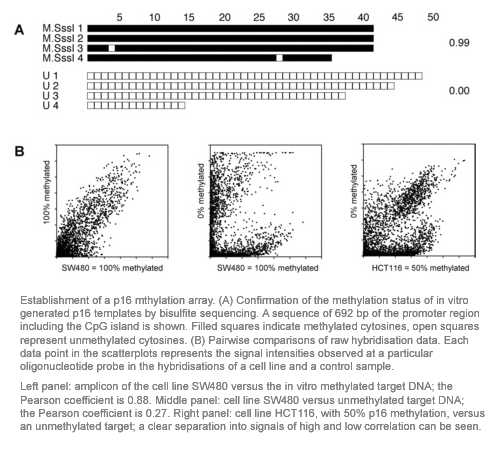
In a pilot study, we studied the CpG island in
the promoter region of the tumour suppressor gene p16.
In total, 876 oligonucleotide probes of 21 nucleotides in
length were used to inspect the methylation status of 53 CpG
dinucleotides,
producing correct signals in colorectal cancer cell lines as well as
control
samples with a defined methylation status. The information was
validated by
established alternative methods. The overall methylation pattern was
consistent
for each cell line, while different between them. At the level of
individual
cytosines, however, significant variations between individual cells of
the same
type were found, but also consistencies across the panel of cancer cell
lines.
...
In
addition, we developed
alternative modes and techniques for
on-chip detection. For example, primer extension reactions were
developed, which reduced significantly
the number of oligonucleotides needed for an analysis and
concomitantly increased
the accuracy of base calling, since the process combines binding to a
complementary oligonucleotide with the specificity of the polymerase.
For
this purpose, we used
and modified in collaboration the APEX
system established in the group of Andres Metspaly
(Tartu University, Estonia). In this process, the chip-bound primers
hybridise to the
genomic sequence directly adjacent to the base of interest. Upon an
incubation with labelled dideoxynucleotides, the fitting nucleotide is
incorporated by the polymerase and can be detected by means of the
specific fluorophore.
|
|
Beier et al. |
(2004) |
BIOforum 05/04, 31-33. |
|
|
|
Mund et al. |
(2005) |
Nucleic Acids
Res. 33, e73. |
|
|
|
Beier et al. |
(2005) |
Exocrine Pancreas Cancer (Gress, T.M. et al., eds.), Solvay, 254-260. |
|
|
|
Beier et al. |
(2007) |
Adv. Biochem.
Engineer/Biotechno 104, Volume: Analytics of Protein-DNA Interactions (Seitz, H., ed.), Springer Verlag, 1-11. |
|
|
|
|
 |
...
|