Medical Physics in Radiology
- Imaging and Radiooncology

Prof. Dr. Mark Ladd
Head of Division and Coordinator of the Research Topic Imaging and Radiooncology
We develop innovative methods for imaging diagnostics and therapy in order to treat cancer patients better and more individually. Our research focuses on new technologies for MRI, PET and optical tomography to obtain important information about tumors and metastases in a non-invasive and gentle manner. In collaboration with clinical partners, our researchers are working on integrating these methods into routine care.
![[Translate to English:] 3D mapping of intracellular pH in a glioma patient](/fileadmin/_processed_/5/4/csm_B%C3%BChnenbild_7a1026239b.webp "3D mapping of intracellular pH in a glioma patient")
Image: 3D mapping of intracellular pH in a brain tumor patient using phosphorus-31 MR spectroscopic imaging at 7 Tesla (method according to Korzowski A et al., 2020, Magn Reson Med, 84:1707-1723). Interpolated pH map overlaid on a clinical contrast-enhanced MRI image., © dkfz.de
Picture Gallery
-
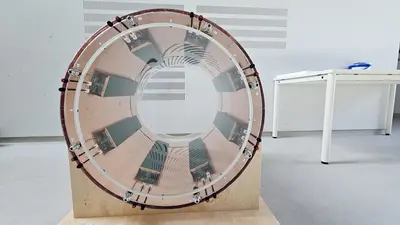
8-channel antenna array for 3T MRI. Designed and built at the DKFZ -
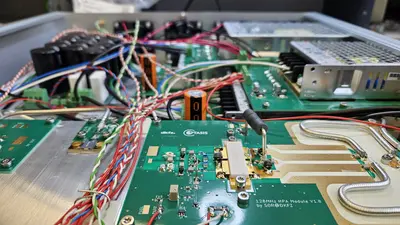
View into a 3T MRI radiofrequency amplifier. Designed and built at the DKFZ -
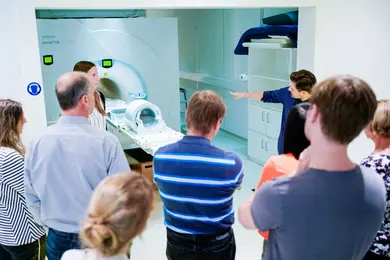
Guided tour at the 7 Tesla MR scanner during the Night of Research -
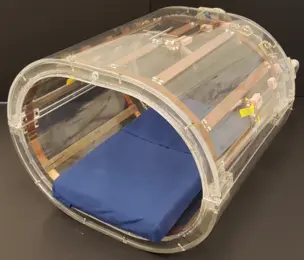
23Na body coil for the application at 7 Tesla, developed and built at the DKFZ. -
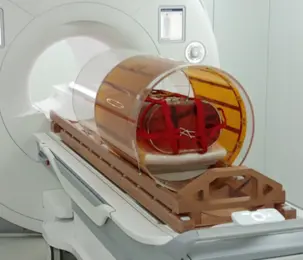
An essentially radiation-transparent body coil integrated with a patient rotation system for MR-guided particle therapy. -
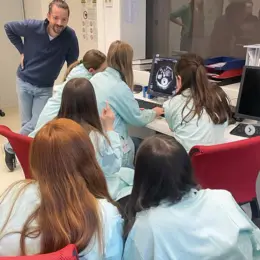
Girls' and Boys' Day: A visit to the 7T MRI


Selected Projects

Standardisation for safe implant scanning in MRI
Within the STASIS project (www.ptb.de/stasis), we are leading work package 2 - reference hardware. In this sub-project, a multi-channel reference transmission system for testing implants is to be realized. The test system consists of an 8-channel array the size of a transmitting body coil for an MRI system, a system for generating 8 independent waveforms and 8 amplifiers with 1000 W power per channel. In addition, there is a simple graphical user interface for operation. All plans for the entire system as well as the software are published under an open source license.

Cross Program Topic Biomedical Engineering

MIB2 – Molecular MR Imaging of the Brain and the Body
As part of the Helmholtz Biomedical Engineering initiative, MIB2 advances Chemical Exchange Saturation Transfer (CEST) MRI, a technique that non-invasively visualizes molecular information beyond the reach of conventional MRI. The project develops robust molecular imaging methods for MRI at ultra-high magnetic field strengths, enabling applications in both the brain and the entire body. By combining expertise from DKFZ and DZNE, MIB2 establishes new imaging biomarkers for cancer and neurodegenerative diseases, paving the way for more sensitive disease characterization and improved clinical decision-making.
Teaching

More information about our seminars and the opportunity to write a bachelor or master thesis in our department are here.
Medical Physics Seminar

The Medical Physics Seminar provides overview talks regarding current status of research and specialized talks concerning advanced topics. This seminar is offered in every term. In the summer term, the seminar ist held by the Division Medical Physics in Radiation Oncology (E040). In the winter term the Division Medical Physics in Radiology administers this seminar on the topic: Radiological Imaging (MRI/CT/PET). More information can be found here.
Team
The Department of Medical Physics in Radiology is divided into various working groups.
- Show profile
Prof. Dr. Mark Ladd
Head of Division and Coordinator of the Research Topic Imaging and Radiooncology
-

Dr. Helen Abeln
Group leader
-

Dr. Marcel Awenius
PostDoc
-

Prof. Dr. Peter Bachert
-
Renate Bangert
Technician
-
Leonie Bartos
B.Sc. student
-
Ute Beutel
Student assistant
-
Frauke Birkenstock
M.Sc. student
-
Prof. Dr. Andreas Bitz
-
Tabita Charlotte Bomhard
Student assistant
-
Dr. Philip Boyd
Group leader CEST Imaging
-
Petr Bulanov
PhD student
-
Silke Cardona
Secretary Research Topic Imaging and Radiooncology
-
Furkan Cetin
M.Sc. student
-
Mirija Class
M.Sc. student
-
Dhritman Dhar
Student assistant
-
Dr. Thomas Fiedler
Group leader
-
Dr. Vanessa Franke
Group leader MR spectroscopy
-
Lucas Freitag
M.Sc. student
-
Max Gorenflo
PhD student
-
Alissa Greshake
Secretary
-

Dr. Johannes Grimm
Research scientist
-
Oliver Gödicke
PhD student
-
Valentin Hahn
M.Sc. student
-
Pablo Jimenez
PhD student
-
Dr. Stefan Kegel
MPE, Radiation Protection Officer
-
Neele Kempa
PhD student
-
Jan Kesting
M.Sc. student
-
Christian Kindtner
Technical assistant
-
Dr. Dorde Komljenovic
-
Lennart Alexander Kopp
B.Sc. student
-
Dr. Andreas Korzowski
Project Coordination MAMMACARE and MIB2
-
Florian Kroh
-

Priv. Doz. Dr. Tristan Anselm Kuder
Group leader & Deputy Head of Division
-
Jana Lechner
M.Sc. student
-

Dr. Alexandra Lipka
Group leader
-

Ignacio Nicolás Lopez Martinez
PhD student
-

Jana Losch
PhD student
-
Franziska Masuch
PhD student
-
Dr. Petr Menshchikov
Research scientist
-
Una Molnar
-
Melanie Müller
Technician
-
Prof. Dr. Armin Nagel
-
Olivia Alison Oetter
-
Dr. Stephan Orzada
Group leader
-
Dr. Jörg Peter
Group leader
-
Andrea Pino Ramos
PhD student
-

Justyna Platek
PhD student
-
Dr. Tanja Platt
Group leader
-

Dr. Anna Scheipers
Research scientist
-
Dr. Simon Schmidt
Group leader
-
Sebastian Schmitter
Group leader
-
Jan-Philipp Schmitz
PhD student
-
Bela Josua Emil Seng
M.Sc. student
-
Noa Maria Sinaga
B.Sc. student
-
Eric Alexander Spennemann
-
Anton Stahl
PhD student
-
Konstantina Stefa
ERASMUS Trainee
-
Maximilian Stucke
M.Sc. student
-
Moritz Thierfeld
M.Sc. student
-
Hannes Trescher
M.Sc. student
-
Dr. Reiner Umathum
Research scientist
-
Francesca Vacca
PhD student
-
Christoph Vovk
B.Sc. student
-
Yuting Wang
PhD student
-
Valentin Wegener
M.Sc. student
-
Jannis Wirtz
M.Sc. student
-

Jinyang Yu
PhD student
-

Henrik zu Jeddeloh
PhD student


News

Current information and news from the department can be found here.
Get in touch with us
